I slept in a little, since my flight wasn't leaving until around 12:45. I still made sure to leave early, bracing myself for a repeat of yesterday. I took a taxi to the all-too-familiar airport, but this time there weren't any problems. As it turned out, the new tickets weren't for KalStar--Zoe and Rachel had misunderstood yesterday. I checked in without a hitch, got my official boarding pass, and moved through security as quickly as possible, afraid they'd call me back and tell me it was all a trick. There were no problems whatsoever, though.
The flight lasted about 45 minutes. I was ecstatic, so I took pictures from the plane that are pretty underwhelming now, but the view had me thrilled at the time.
Borneo is the third-largest island in the world, after Greenland and New Guinea. Three countries have territories on the island: Brunei, a small country on the northern coast; Malaysia, whose state of Sarawak occupies the northern part; and Indonesia, whose territory comprises three-fourths of the island. Outside of Indonesia, the region is called Kalimantan, but Indonesians refer to the entire island by the same name. The island is chock-full of biodiversity. There are an estimated 15,000 different species of flowering plants, 3,000 species of trees, 221 species of terrestrial mammals, and 420 species of resident birds--and those estimates are from 1998. New species are being discovered all the time: according to the World Wildlife Fund, 361 speices have been discovered since 1996, with 52 more found between July 2005 and December 2006 alone. Borneo has its own subspecies of elephant. It's also home to the Bornean orangutan and the proboscis monkey. None of them are found anywhere else in the world.
The island is also home to about thirty different indigenous groups of people. One of my anthropology professors at UGA, Pete Brosius, conducted field work with the Penan, one of those groups. He talked at length about them, teaching us about their lifestyle. One of the last known groups of truly nomadic hunter-gatherers in the world, they are gradually forming settlements in response to the pressures of habitat destruction. Dr. Brosius lived with the Penan during a time when the logging industry in Borneo was booming, and watched firsthand as the Penan struggled with the loss of their territory to timber companies.
All of this was going through my head on the plane, and had been since we got in the van the day before in Jogjakarta. The flight itself was uneventful. Our plane, though, boarded from both the front and the back, which I thought was a ridiculously good idea. As we got off the plane in Pangkalan Bun, people were allowed to come out onto the tarmac to meet the arriving folks. I was greeted by two men. Anang introduced himself as my guide, and the other man (whose name I forgot) was our driver for the day.
As we waited at baggage claim, I finally got to meet Nanang. He was grinning when I met him, and laughed as I apologized for all the craziness from the day before. I knew we had been an enormous hassle for him--in the span of two hours, he arranged three different sets of flights for us, had to reorganize the tour, and deal with our crummy airline--but he didn't let it show at all. His main concern was the girls: why had they suddenly changed their minds? When I explained that they thought we'd be flying with KalStar, even though we weren't, he laughed. He shrugged and said it was their loss, which I completely agreed with.
We quickly worked out the details for the next day's flight to Jakarta: he would have the ticket and what was left of our refund waiting for me in Pangkalan Bun the next morning. With that, Anang and I hopped in a car with the driver, and took off.
We first had to drive from Pangkalan Bun to Kumai, about half an hour away. Along the way, Anang and I talked about all kinds of things. He was born and raised in Kalimantan, and his father was the chief if a local tribe. (More on that later.) His English was nearly flawless, which he says he owes to all the tourists he's met. He also told me he likes country music, thanks to a tourist from Texas last year, and his favorite artist is Kris Kristofferson.
The drive from Pangkalan Bun to Kumai was very flat, with forests cleared away about 50 feet on either side of nicely-paved roads. For some reason, it reminded me of driving around in Florida, particularly Highway 85 between Crestview and Ft. Walton Beach. We got to Kumai, a small town on a river of the same name. There wasn't much development, and we headed down a dirt road lined with plain wooden houses. We stopped at one, got my stuff, and headed back to the dock. The houses were built so close together that the docks were practically joined into a continuous stretch of boardwalk. Some kids came out to gawk at me, giggling when I waved and said hello in Indonesian. There were several boats--this one, this one, and this one, for example--and I immediately began wondering which one I'd be on.
Anang explained that the longboat we'd be using for the tour (identical to the one in the first of those three pictures) had left yesterday, even after our flight was cancelled. I'm not exactly sure why it did this; maybe it was to save time. For whatever reason, we'd be taking a speedboat to meet the original boat. Sure enough, a few minutes later a tiny speedboat came zipping along to pick us up.
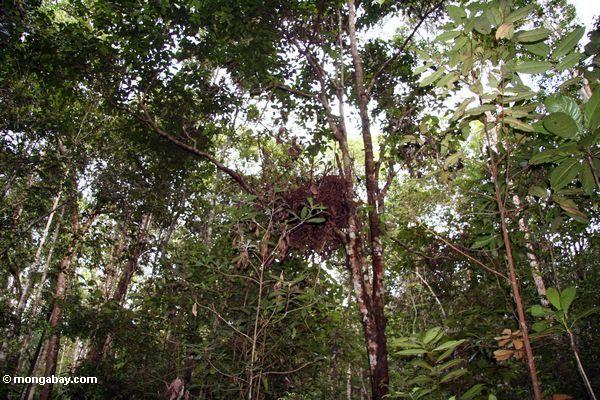
We headed down the Kumai for a little, before heading west on the Sekonyer, a smaller branch. As we sped along, Anang told me to be on the lookout for estuarine crocodiles, proboscis monkeys, and, of course, orangutans. I spotted the snout of a crocodile, but couldn't get my camera out fast enough. While we didn't see any non-human primates, Anang did point out a few orangutan nests in the treetops. At first I thought I was misunderstanding him, but sure enough, orangutans build a new nest for themselves every night.
At some point along the Sekonyer, we officially entered Tanjung Puting National Park, which spans 4,000 square kilometers of rain forest. The park has existed for about 65 years, and was established primarily for the preservation of the Bornean Orangutan. Camp Leakey manages the rehabilitation of captured orangutans, and releases them into the park.
We slowed as we passed some local fishermen, and to wave at some kids on a small dock. We passed by a boat identical to ours with another tourist group, heading back to Kumai. The water in those pictures is brown and cloudy from silt; Anang explained that there is a zircon mining operation far up the Sekonyer, and runoff from the mining is silting up the river.
We soon turned off the Sekonyer to an even narrower river, and the change in water color is remarkable. This type is known as a blackwater river, and gets its color from tannins leached from nearby leaves. There wasn't much of a current, which caused the water ahead of us to mirror the canopy beautifully.
We finally got to a dock where three identical boats were anchored. One of them was ours, and we climbed aboard. The crew consisted of Anang, a cook, a driver, and two other members. I felt kind of silly, having a boat and crew of five commissioned just so I could be an eco-tourist. Of course, it didn't seem to bother them too much, though I did apologize to the guys for not bringing two girls with me.
The cook had prepared lunch for me, and since I was all by my lonesome, Anang ate with me. The meal was simply delicious: rice, steamed vegetables, and grilled chicken. They had brought hot sauce, ketchup, and a sweet soy sauce that was thick like syrup. Having expected to rough it with plain rice and water, I was pleasantly surprised.
After eating quickly, Anang and I set out for feeding time. Twice a day, at two or three places around the park, the park puts out bananas for the local orangutans. This serves several purposes, including helping the recently-reintroduced orangutans who are still learning to fend for themselves, helping the park workers keep track of the orangutans, and allowing an excellent opportunity tourists to view the orangutans.
Anang advised that I bring very little with me, to reduce the chances of an orangutan approaching me out of sheer curiosity. He assured me that the orangutans in the park have not attacked any visitors, but did say that they will sometimes charge at people. He told me that as long as I listened to him, we'd be fine. As he said all this, he sounded serious without trying to scare me. Ever since I set out for Japan, I've taken a remarkably carefree approach to danger like this, deciding that I'm not going to let fear of something awful happening (plane crash, falling off an elephant, being bitten by a monkey, catching malaria, assaulted by an orangutan) keep me from doing the things I want to do. Thanks to that and Anang's frankness, I wasn't the least bit worried about what we'd find.
We started down a long boardwalk spanning marshland. Not five minutes after leaving the boat, we saw this. Anang instantly recognized the orangutan as a female with her baby, and knew exactly which one she was. He warned me with a grin that she is the "naughty one." As we got closer, I managed to get this picture before Anang decided to toss a few bananas into the water off the boardwalk. The mother casually reached for a nearby tree, scaled down it, fished out the bananas, and swung back onto the boardwalk as we briskly walked past her.
As we headed on to the feeding place, we passed another orangutan poking around for food. This one didn't seem to pay us the least bit of attention.
The feeding place is a roughly 10' x 10' wooden platform raised about six feet off the ground. Very little of the forest has been cleared around the platform, and the viewing area consists of two or three simple benches. There were about twenty other tourists and guides gathered, and all of them were sitting in complete silence, watching the platform. We quietly took a seat among them, and watched.
There were a few orangutans near the platform, taking turns grabbing bananas and munching on them. Some were sitting on the platform, while others would take their snack up a nearby tree before enjoying it. As we watched, more of them slowly made their way from all directions toward the platform. Just as with the ones we passed on the way in, none of them seemed interested in us in the slightest. Eventually there were about ten orangutans on or around the platform, just chilling out and eating. Most of them were females, and several of those had babies, which were clinging to their mother's body, occasionally reaching up to take some food. This picture shows a baby, as well as just how close they were to us.
Between us and the platform was the simplest and smallest of fences, clearly intended merely to maintain a minimum distance from the platform. Anang assured me I could go all the way up to the fence; that's where this picture and this picture came from. While I was pausing between shots, staring at the scene around me, and trying to make sure I was really seeing this, a lady next to me struck up a conversation. I learned that she was from Wisconsin, and was on vacation with her husband. Their son is also doing the JET program, and just like my mom would do, she asked if I knew him. As we were talking, her husband heard me reply to her with "yes, ma'am" and "no, ma'am," and so he asked me with a grin where I was from. It turned out that he was from Tennessee, and could tell I was a southerner just from hearing that.
I also saw two familiar-looking guys: the two from the airport the day before, who had managed to get their tickets. We introduced ourselves (they're from San Francisco) and had a laugh about the whole thing. They gave me the rest of their story, which I've already used to sort of retrofit my account of yesterday's debacle.
I made my way back to Anang, who began telling me about the orangutans. They live about fifty years, reach sexual maturity at about fifteen, and are pregnant for nine months, all of which, he pointed out, are similar to humans. The child stays with its mother for about six years, then goes off on its own. According to Anang and every other source I've found, orangutans live solitary lives. Apart from mating and child-rearing, they have little to no social interaction. For all the hullaballoo that we primates get for being social creatures, I find this lack of sociality fascinating.
Camp Leakey specializes in rehabilitating rescued orangutans. They acquire orangutans from several different sources. Some are taken from habitat that is slated to be cleared by loggers, and are relocated to the park. Others are babies that are found alone, their mother having been killed by poachers. Still others are donated by regular people who owned them as pets.
There's apparently a substantial demand for exotic pets, which includes orangutans. In response to that demand, hunters seek out baby orangutans. The mother will not allow her baby to be taken, so she is often killed in the process. The baby is then delivered to the people who ordered it, and raised as a pet. Docile and manageable enough when they're young, adult orangutans (especially males) require a lot more food and territory than most private owners can provide. Once their pet has grown too big for them to handle, the owners turn it over to places like Camp Leakey. There, workers try to rehabilitate it, helping it grow accustomed to living in the wild.
The sexually mature males are fiercely territorial, which explains why the only males we saw at this platform were adolescent: we were in the territory of the biggest male in the park. We talked about this as the others trickled away, watching the orangutans finish their meal--fruit and peel alike--and head back up the trees. I was amazed at how dexterous they were, shimmying up and down trees in a way that made me think of Donkey Kong Junior. Just as we were leaving, we heard a boar rooting around for scraps.
On our way in, we had taken a path away from a group of huts, which Anang had identified as the main buildings of the camp. We stopped there on the way back, and he showed me around. These buildings were situated among the trees, with no barriers of any kind between the houses and the forest. Sure enough, we passed a couple of orangutans in the trees overhead. Anang led me to a house so he could ask one of the workers if they'd seen the big male. The male, nicknamed "Tom" and "The King" by the workers, had been seen nearby just a few minutes before, so we began looking around. After about five minutes, we found him, no more than fifty feet from the house.
Tom was huge. Anang told me he clocks in at about 135kg--just under 300lbs. He's somewhere around five feet long, which makes those 135kg look that much bigger. As we watched, he was just hanging from a tree. He yawned, showing me exactly what a fellow male would have to look forward to in a fight. Anang showed me how close I could get, and gestured for me to stand closer so he could take our picture. While we were watching Tom, I heard a sound, and turned to find that a female had dropped down onto the roof and was nosing around the back of the house. A minute later, I noticed a boar had emerged and was sniffing around the yard. We were literally right in the middle of all this.
Anang pointed out the pronounced pads of skin on either side of Tom's face, and the pouch of skin hanging down from his neck. He explained that males that assert and defend territory develop these characteristics; males without territory don't have them. I later found out that these pads are called flanges, and that flanged males use their throat pouch to produce booming calls that attract females. Unflanged males, meanwhile, have to force themselves on females.
After a few minutes, Tom began climbing away, so Anang and I excused ourselves and hiked on. Anang explained how clever the orangutans are: they are fully capable of opening bolt locks, and can easily untie knots. He told me about an old female who used to get jealous of women visitors to the camp who walked alongside men. She would apparently run up to them, trying to scare off the women. They will also jump into boats, and paddle with their hands. Anang said that park workers who use small boats have to partially sink them to prevent the orangutans from stealing them.
As we were talking, we heard a woman's scream from nearby. It was more angry than shrill, so we ran toward it more out of simple curiosity than concern. We found a mother and her baby eating some rice that was strewn on the ground. Anang talked to the lady who had screamed, and explained that she had found the mother nosing around her stores of rice. She had thrown some out into the grass and shooed them off the porch. As with the rest, the mother didn't really seem to acknowledge our existence. If we moved toward her, she took notice, and would move away by the same distance if we got too close. Otherwise, though, she went about her business. Anang took this picture for me. I grabbed one more before we headed on.
We made it back to the boat and had a snack of chips, small pastries, and tea. The boat had a simple toilet at the back, which included a showerhead fed by a pump that drew river water. Anang called it a "jungle shower." After all the sweating we'd done, I availed myself of the shower.
Anang and I snacked and chilled out on the boat as we headed upstream a little. It was about 5:30, but it was already getting dark. Anang and I talked about all kinds of things. He asked me about America and Japan, and I asked him about life in Kalimantan. He told me about a big tribal war that broke out about ten years ago. According to him, it began when one "ethnic" (the way he described ethnic groups) had declared a certain city to be theirs, and had begun killing other groups in the city. This attracted the attention of all the tribes of the island, who sent their warriors to fight the instigators. Anang's father, the head of one of the local tribes, was killed one month after Anang got married.
He went on to tell me about one of the tribes, the Punan, who are reputed to be the best hunters in the island. They're known for being able to walk at night without any difficulty seeing. I tried looking them up, but apparently there are about twenty different tribes currently identified as "Punan" of some kind or another.
When we planned this trip, we were given two options for sleeping arrangements: a lodge located on land, or the boat itself. Not sure which was better, the three of us split the difference, taking one night in each. Amid all the changing of plans, I decided to sleep in the boat. Anang had brought some mosquito netting that some tourists had left him, so I used one that basically formed a see-through tent. I put on some more mosquito repellent, admired the swarm of bugs clumping around the one light still on (which was conveniently right above my bed), then turned the light off and went to bed. I slept fine--after getting used to a futon on tatami for eight months, it's amazing how easily I can sleep elsewhere.
Wednesday, April 30, 2008

Tuesday, April 29, 2008
DAY FIVE: Semarang
Zoe, Rachel, and I woke up at about 6, dragged ourselves down to the lobby, and woke up over a continental breakfast. Looking back, it was actually really tasty, but I wasn't awake enough at the time for "delicious" to register. Our driver arrived right on time.
This part of the trip was what I'd been looking forward to the most. We were going to fly to Borneo to visit Tanjung Puting National Park, an orangutan preserve. The tour would include three days and two nights in the park itself, traveling primarily by boat, exploring on foot, and accompanied by a guide. This was the website we booked the tour through, and I had been going crazy from anticipation all week long.
Working out the logistics of getting there had been tricky. The airport nearest the park was in Pangkalan Bun, and only flew to Semarang, a town on the northern coast of central Java. While we could have flown from Jogja to Semarang, it would've cost about $100 per person. After extensive discussions with our tour contact, Nanang, we had decided to take a three-hour van ride, which cost a total of $54. We could have gotten there a lot faster, but our flight wouldn't leave until after noon anyway. The plan was thus to ride to Semarang and fly to Pangkalan Bun on Tuesday, spend all day Wednesday in Borneo, then fly back to Semarang then Jakarta on Thursday.
So our driver picked us up in Jogja right on time. Like everyone else remotely involved in the Indonesian tourist industry, he spoke impressively good English. He wasn't very talkative, but that didn't bother us. Rachel dozed, and Zoe and I talked about all kinds of random things, like politics, accents, conservation, and teaching. The drive was on a two-lane road, and traffic slowly got worse as we went on. Passing eighteen-wheelers on winding country roads is thrilling and terrifying no matter what country you're in.
We finally got to Semarang, and the driver carried our bags in for us. He also came with us to help get our tickets. After a minute or two of watching him talk to the guys at the counter, we could tell something was wrong.
He came back to us and told us that the flight had been cancelled. I had checked my email the night before, and Nanang had told me that, indeed, our original flight had been cancelled, but that he had put us on the next flight--departing about 45 minutes later--and that everything would be fine. The driver told us that the desk had told him that our flight had been cancelled. Our first question was whether there were open seats on other flights for the day. He asked the desk, and told us everything was full. We wanted more information, and the driver talked some more to the desk. He then called Nanang, and while he was speaking to him, we saw two more whities walk up to the counter area.
They saw us standing near the counter, and didn't want to cut in front of us. When we explained that we weren't in line, they saw the looks on our face and asked if something was wrong. We found out they were going to Pangkalan Bun, gestured to the desk, and wished them the best of luck. The two of them stepped up, and soon found out the same news we had. They got on the phone with whoever had booked the trip for them.
Another man who had been displaced sat down next to me. He was a local businessman, heading to Borneo for some kind of meeting. His English was very good, and he was very mad about the situation. He suspected there was more going on with KalStar than they were telling us.
Meanwhile, Nanang asked to speak to me. KalStar (the airline), had told him that they had cancelled our flight for maintenance, and had reserved spots for us on another flight to Pangkalan Bun, through Linus, another airline. According to them, that made it no longer their problem. We spoke to Linus, who told us that they didn't have reservations for us, either. Not sure who to believe, I skipped being mad about it and tried to figure out what to do next. The next flight to Pangkalan Bun wouldn't be until the next day. Nanang apologized, and his immediate suggestion was to bump the whole plan back a day--he would cover the cost of rescheduling flights for us, and everything would be fine. We couldn't do that, though--Mutia's cousin's wedding was Friday, giving us no wiggle room. He understood, and next offered to give us a refund for that day's portion of the trip and pay for a hotel for the three of us in Semarang for the night. We would still get to take the remaining portion of the tour.
We asked for a few minutes to discuss it--up until now this had been just between Nanang and me--and said we'd call him back. None of the three of us liked the revised plan. We looked at it this way: under the revised plan, we wouldn't get to Borneo until Wednesday afternoon, and we'd be leaving the following morning, so we wouldn't even get 24 hours in the place. Considering the amount of the refund he was offering us, we didn't think it was adequate for the time we'd be missing. So we decided to call the whole thing off, get our money back, and do something else with the next two days.
I called Nanang back and explained our decision to him. He understood, but explained that with so much of the trip cost having already been spent--booking our flights, the van ride, etc.--he couldn't give us a full refund. I explained this to the girls, who reluctantly agreed. We worked out the refund arrangements, and Nanang helped us book a flight to Jakarta. Our plan became to rendezvous with Mutia and find something else to do. Our driver asked us if he could do anything else for us. He wasn't in this for a tip--he genuinely sympathized with us, stranded as we were, and wanted to help us out. We thanked him, tipped him, and sent him on his way.
Meanwhile, the two other displaced travelers had not left the KalStar desk. At one point we eased toward them, waited for a break in the conversation, and asked if they'd found anything out. KalStar had told them exactly what they'd told us. As far as the guys were concerned, that indeed made it Linus' fault, so they went to take it up with them. (Linus' desk is conveniently right next to KalStar's.) They soon found out, though, that although KalStar had called Linus to make reservations for us, they had never paid for the tickets. When the payment deadline passed, Linus cancelled our flights just like they'd do for any customer. So that made it KalStar's fault again.
The guys had then turned their rage back at KalStar, and had pieced together the scenario. They deduced that the original KalStar flight had only eleven or twelve passengers, which wasn't enough to operate the flight at a profit. So they'd cancelled the flight, citing maintenance issues. Though they booked passage on another airline, they could save money by giving those displaced passengers otherwise empty seats on the next day's flight. So they hadn't paid for the tickets, let the deadline pass, and would give us little tourists two options: fly the next day, or don't fly at all.
However, since we had seemingly resolved our situation, we decided to calm down and have some lunch. The airport had a KFC with an interesting menu, and Rachel and I eagerly ordered some. Thanks to all the stress in dealing with the airline, Zoe didn't have much of an appetite. We sat and talked things over.
In the meantime, the guys, having figured out the real story, decided to make a stink about it. They called the lady who had booked their trip, and had her help them rant and rave at KalStar to fix it. Their case was perfectly legitimate: KalStar had cancelled the flight after confirmation yesterday, but had not contacted anyone--neither their lady nor Nanang had heard anything from them. I started to be slightly embarrassed at my countrymen's behavior, but lo and behold, soon they were walking briskly away, shiny boarding passes in their hands.
Though we were happy for the guys, this of course didn't make us like KalStar any more. After hearing the guys' story, the girls had gradually been seething more and more about the whole thing. I personally didn't care: the only way for us to get on a flight to Pangkalan Bun that day would be to bump someone else. I saw nothing right in bumping three unsuspecting travelers who had done nothing wrong. The girls agreed, but still found it unacceptable that KalStar would come away from this more or less unscathed.
As I continued to calm down, the realization began to sink in that I'd likely never get another chance like this again. Even with a shortened trip, we'd still get a full day in Borneo with orangutans. I voiced this, and the girls sort of wavered. I wasn't totally comfortable with going on the trip alone, and I certainly didn't want to abandon the girls, so I wanted to make sure that, whatever we did, we did it together. We began considering Nanang's original offer: partial refund, hotel, and shortened trip. After comparing the full refund we'd decided to take with the partial refund he had offered us, we realized that we'd basically only be paying the difference between those refunds to take that shortened trip. Looking at it that way, we decided to call Nanang back and ask about the offer.
With the driver gone, we had to find another way to call Nanang. There aren't really any phone booths in Indonesia. Instead, the airport had basically the telephone equivalent of an Internet cafe: a desk worker and three stalls with phones. There were a few other people hanging out in the room, and they all were very helpful. Between my fledgling Indonesian and their fragmentary English, we understood each other. I called Nanang and asked him about the previous offer. Expecting him to be irritated at the flip-flopping (justifiably so, in my mind), I was surprised when he started laughing. That sort of scared me, too--I was momentarily afraid he was going to freak out at me--but then I realized he was genuinely amused. He told me we could take the original offer, though he had already booked the flights to Jakarta, and that the price would have to be taken out of the refund. I totally understood that, and asked him to let me talk to the girls before he made any more changes.
I got off the phone, paid the lady (about $2), and went back to the girls. They didn't like the reduction in the refund, but agreed to it. So I called Nanang back and accepted the offer. He told me to give him about 15 minutes to make the arrangements. I thanked him, hung up ($2), and went back to wait with the girls. About 15 minutes later, an unfamiliar face emerged from the KalStar office. This guy looked different from the other workers--he wasn't wearing any discernible uniform, and was instead wearing slacks and a dress shirt. He presented me with the three tickets for the next day's flight. As I gave them to the girls, they got a lot more upset. Since the man had come from KalStar's office, the girls thought that meant we'd be flying KalStar the next day. Thoroughly disgusted with the airline, they wanted nothing to do with them. That was enough to make them call the whole thing off.
After making that last call to Nanang, I had decided that I was going, regardless of what the girls wanted to do. When I asked them if they were sure about this, and they said yes, I explained that I was going on to Borneo. They totally understood, and had no problem with it--they just didn't want anything to do with KalStar. I asked the man to call Nanang, and when I explained what the girls were doing, he started laughing again. This time, though, the phone cut out, which left me unsure whether the call was dropped or he had hung up on me. Zoe and Rachel gave me their tickets to Pangkalan Bun, got their tickets for the Jakarta flight (which was boarding), and rushed off to get checked in.
Left alone and slightly stunned, I went back to the phone booth to call Nanang. I apologized about the girls changing their mind so much, but explained that I still very much wanted to go on the trip. I added that I understood completely if he felt it was too much trouble and wanted to call the whole thing off. He sounded more flabbergasted than angry, and said there would be no problem taking me on the tour, as long as I wouldn't mind being alone. He had made the hotel reservations, and said someone would be along to pick me up soon.
That done ($2), I went back to KalStar to return the girls' tickets. I signed for mine, paid the man, and collected my things to wait for the shuttle. While I was waiting, I noticed the airport had a Dunkin Donuts that offered, among others, durian-filled pastries. I haven't quite acquired a taste for the stinky fruit yet, so I had to pass.
The shuttle picked me up without a hitch, and we set off for the hotel. The driver's English was very good. We passed by several buses along the way, and I noticed that the back door on the buses was left open. Whenever the bus stopped, people would hop on or off as they pleased. The hotel was very nice. I had a double room to myself, since Nanang had booked it originally for the three of us. I relaxed for a minute or two, then decided to go adventuring in Semarang.
I started out by flipping a coin and heading right outside of the hotel. I followed that road for about ten minutes and, seeing nothing interesting, turned back and went the other way from the hotel. I have no idea what part of town I was in, whether it was a main thoroughfare or a normally-congested area. The road in front of the hotel, though, had about six lanes of traffic, and all of them were congested as I was walking along. It was right around 5pm, so I guess I hit peak rush hour.
Along the way, I passed several bicycle-drawn carriages, with the drivers advertising to anyone walking by. I noticed some delivery bikes for KFC. After a few minutes, it started to rain. It didn't look like a set-in rain--more like a familiar gone-in-ten-minutes burst--so I ducked into a convenience store. I browsed idly for a few minutes, but soon gave up and bought an umbrella. Sure enough, the rain stopped about ten minutes later.
After about half an hour of determined walking (and darting across intersections with crosswalks but no crossing signals), I found a nice shopping district with a few big malls. I had been secretly hoping for an opportunity to eat alone somewhere in Java ever since I saw this in Jogjakarta. Lo and behold, I found a Pizza Hut.
Most of the people I know cock their heads and crook their eyebrows at me when I talk about Pizza Hut. I don't care. I love Pizza Hut. It's simply my favorite pizza, ever. I'll take it over almost any other pizza--chain or mom-and-pop--I've ever had. (The only exception is the James River Grill's smoked pulled pork pizza, but they're closed now.) A lot of my friends know that, when I'm on a road trip by myself, I'll eagerly stop for lunch at any of the remaining Pizza Huts that offer lunch buffets. It's the perfect meal, as far as I'm concerned: it's cheap ($4.99); it eliminates the one problem with ordering pizza (the wait); I prefer half-hour-old heat-lamped pizza to fresh pizza anyway; and they're owned by Pepsi, which means they have Mountain Dew (another vice of mine). I can be in and out, stuffed with pizza and Mountain Dew, for $10 in 15 minutes. To me, that's perfection.
To go just a little further with this bizarre tangent, Pizza Hut is one of the foods I crave the most since leaving the country--they don't have many in Japan, and there certainly aren't any on Tsushima. (The only food I crave more is barbecue--specifically ribs from the Barbecue Shack in Toccoa.)
I made it a point to go to the one in Springfield when I went home for Christmas, and I'll be doing the exact same thing next time I go home.
Chase and I ordered Pizza Hut at a take-out-only shop in Louisville, Kentucky (it might have been Lexington...), during our four-day, seven-state road trip five years ago, toted it twenty minutes to a local state park, and feasted there.
I stayed behind in Budapest for about a week after the main group departed, and made it a point to visit the bistro-style Pizza Hut I'd seen earlier.
When I drove out to see Kristi, Mary, and Chris last summer, I stopped for supper at a Pizza Hut in Laramie, Wyoming.
When I left the Weeville Beta in Tampa last July, I stopped for lunch at a Pizza Hut as I finally let myself tear into Harry Potter 7.
And am I the only one who used to get free personal pan pizzas for doing Pizza Hut's Book It! program?
Now that the reader has gained some perspective on my love of Pizza Hut, I can continue. I found a Pizza Hut in Semerang. As I walked up the stairs (a second-story Pizza Hut! oo!), I noticed this one looked pretty ritzy for a pizza chain. Sure enough, the interior had a much more swanky feel than the poorly-lit restaurants I'm used to. The hostess seated me, though the place was pretty empty. I thumbed through the menu, found they had almost everything I expected them to (except Mountain Dew, unfortunately), and decided to resist the urge to pig out. I opted instead for a personal pan pepperoni lovers with stuffed crust, and a strawberry iced tea, just because it sounded too good to pass up.
The tea was basically Brisk with strawberry syrup added, which was fine by me--in my experience, cold, sweetened tea is a rarity in Asia. The food didn't take long, and it was, of course, pure heaven. I tried not to eat too quickly, but you can only slow down so much with four slice of pizza. I finished up, asked the waitress for the bill, and spent about five minutes trying to understand it. I'm used to Pizza Hut being expensive. In fact, that's the main reason folks give for not liking it. I'm accustomed to a large pizza being somewhere in the neighborhood of $12, which means $15 after you tip. I haven't paid for a personal pan pizza in a long time, so I'd guess they run about $5-$7. Even in Budapest, the prices were comparable--overpriced by Hungarian standards, but more or less on target for a Pizza Hut. In Indonesia? Not so much.
My personal pan pizza cost me $1.50. The drink almost cost more than the food--$1. I looked back through the menu and learned that full-sized pizzas topped out at about $5, and even that was with all the accessories that nobody ever gets. I simply couldn't believe it. Mutia had from day one cautioned us against giving standard U.S.-scale tips--my restaurant roots compel me to tip at least $5 unless you spill coffee on me, and sometimes even then, if you apologize enough--so I only left the girl $2. I guess I shouldn't feel like a cheapskate for that: I didn't get any refills, and my meal cost $2.50, after all. Basically, I ate Pizza Hut for about the same amount as a a waffle at Waffle House.
In shock, both from the bill and from the flavor, I lingered for a while. I left the restaurant and strolled around the area. I found a five-story shopping mall and decided to browse. Inside, it was crowded and pretty run-down. The setup was similar to what I'm used to--department stores, arcades, a food court, etc.--and I guess that's what made it look so grimy by comparison. As I was getting off an escalator, I felt someone bump into me from behind. When I turned to look, I saw a guy walking away quickly. I would've been more concerned, but I'd already moved everything important to my front pockets. Satisfied at having triumphed over my first pickpocketer, I kept my hands firmly planted in my pockets for the rest of the night.
I found a couple of movie theaters, but decided it was too late to take in a movie. Instead of framed posters and marquees, though, the theaters had huge tapestry-looking posters advertising the movies. The ones in Indonesian didn't look that strange, but Iron Man was just about to come out, so there was a big tapestry with Robert Downey, Jr. on it. I wish I'd gotten a picture of it.
On the trek back to the hotel, I got lost a couple of times. I didn't panic, instead looking at it as a challenge, and each time I successfully retraced my steps. I knew the whole time that all I had to do was hail a taxi or, if worse came to worst, hire a bicycle carriage.
I got back to the hotel and called Mutia at home. The girls had gotten in touch with her only a little while earlier. They were fine, and had gotten situated in a hotel in Jakarta. We worked out the plan for picking me up in Jakarta, talked for a little, and then I went to bed.
This part of the trip was what I'd been looking forward to the most. We were going to fly to Borneo to visit Tanjung Puting National Park, an orangutan preserve. The tour would include three days and two nights in the park itself, traveling primarily by boat, exploring on foot, and accompanied by a guide. This was the website we booked the tour through, and I had been going crazy from anticipation all week long.
Working out the logistics of getting there had been tricky. The airport nearest the park was in Pangkalan Bun, and only flew to Semarang, a town on the northern coast of central Java. While we could have flown from Jogja to Semarang, it would've cost about $100 per person. After extensive discussions with our tour contact, Nanang, we had decided to take a three-hour van ride, which cost a total of $54. We could have gotten there a lot faster, but our flight wouldn't leave until after noon anyway. The plan was thus to ride to Semarang and fly to Pangkalan Bun on Tuesday, spend all day Wednesday in Borneo, then fly back to Semarang then Jakarta on Thursday.
So our driver picked us up in Jogja right on time. Like everyone else remotely involved in the Indonesian tourist industry, he spoke impressively good English. He wasn't very talkative, but that didn't bother us. Rachel dozed, and Zoe and I talked about all kinds of random things, like politics, accents, conservation, and teaching. The drive was on a two-lane road, and traffic slowly got worse as we went on. Passing eighteen-wheelers on winding country roads is thrilling and terrifying no matter what country you're in.
We finally got to Semarang, and the driver carried our bags in for us. He also came with us to help get our tickets. After a minute or two of watching him talk to the guys at the counter, we could tell something was wrong.
He came back to us and told us that the flight had been cancelled. I had checked my email the night before, and Nanang had told me that, indeed, our original flight had been cancelled, but that he had put us on the next flight--departing about 45 minutes later--and that everything would be fine. The driver told us that the desk had told him that our flight had been cancelled. Our first question was whether there were open seats on other flights for the day. He asked the desk, and told us everything was full. We wanted more information, and the driver talked some more to the desk. He then called Nanang, and while he was speaking to him, we saw two more whities walk up to the counter area.
They saw us standing near the counter, and didn't want to cut in front of us. When we explained that we weren't in line, they saw the looks on our face and asked if something was wrong. We found out they were going to Pangkalan Bun, gestured to the desk, and wished them the best of luck. The two of them stepped up, and soon found out the same news we had. They got on the phone with whoever had booked the trip for them.
Another man who had been displaced sat down next to me. He was a local businessman, heading to Borneo for some kind of meeting. His English was very good, and he was very mad about the situation. He suspected there was more going on with KalStar than they were telling us.
Meanwhile, Nanang asked to speak to me. KalStar (the airline), had told him that they had cancelled our flight for maintenance, and had reserved spots for us on another flight to Pangkalan Bun, through Linus, another airline. According to them, that made it no longer their problem. We spoke to Linus, who told us that they didn't have reservations for us, either. Not sure who to believe, I skipped being mad about it and tried to figure out what to do next. The next flight to Pangkalan Bun wouldn't be until the next day. Nanang apologized, and his immediate suggestion was to bump the whole plan back a day--he would cover the cost of rescheduling flights for us, and everything would be fine. We couldn't do that, though--Mutia's cousin's wedding was Friday, giving us no wiggle room. He understood, and next offered to give us a refund for that day's portion of the trip and pay for a hotel for the three of us in Semarang for the night. We would still get to take the remaining portion of the tour.
We asked for a few minutes to discuss it--up until now this had been just between Nanang and me--and said we'd call him back. None of the three of us liked the revised plan. We looked at it this way: under the revised plan, we wouldn't get to Borneo until Wednesday afternoon, and we'd be leaving the following morning, so we wouldn't even get 24 hours in the place. Considering the amount of the refund he was offering us, we didn't think it was adequate for the time we'd be missing. So we decided to call the whole thing off, get our money back, and do something else with the next two days.
I called Nanang back and explained our decision to him. He understood, but explained that with so much of the trip cost having already been spent--booking our flights, the van ride, etc.--he couldn't give us a full refund. I explained this to the girls, who reluctantly agreed. We worked out the refund arrangements, and Nanang helped us book a flight to Jakarta. Our plan became to rendezvous with Mutia and find something else to do. Our driver asked us if he could do anything else for us. He wasn't in this for a tip--he genuinely sympathized with us, stranded as we were, and wanted to help us out. We thanked him, tipped him, and sent him on his way.
Meanwhile, the two other displaced travelers had not left the KalStar desk. At one point we eased toward them, waited for a break in the conversation, and asked if they'd found anything out. KalStar had told them exactly what they'd told us. As far as the guys were concerned, that indeed made it Linus' fault, so they went to take it up with them. (Linus' desk is conveniently right next to KalStar's.) They soon found out, though, that although KalStar had called Linus to make reservations for us, they had never paid for the tickets. When the payment deadline passed, Linus cancelled our flights just like they'd do for any customer. So that made it KalStar's fault again.
The guys had then turned their rage back at KalStar, and had pieced together the scenario. They deduced that the original KalStar flight had only eleven or twelve passengers, which wasn't enough to operate the flight at a profit. So they'd cancelled the flight, citing maintenance issues. Though they booked passage on another airline, they could save money by giving those displaced passengers otherwise empty seats on the next day's flight. So they hadn't paid for the tickets, let the deadline pass, and would give us little tourists two options: fly the next day, or don't fly at all.
However, since we had seemingly resolved our situation, we decided to calm down and have some lunch. The airport had a KFC with an interesting menu, and Rachel and I eagerly ordered some. Thanks to all the stress in dealing with the airline, Zoe didn't have much of an appetite. We sat and talked things over.
In the meantime, the guys, having figured out the real story, decided to make a stink about it. They called the lady who had booked their trip, and had her help them rant and rave at KalStar to fix it. Their case was perfectly legitimate: KalStar had cancelled the flight after confirmation yesterday, but had not contacted anyone--neither their lady nor Nanang had heard anything from them. I started to be slightly embarrassed at my countrymen's behavior, but lo and behold, soon they were walking briskly away, shiny boarding passes in their hands.
Though we were happy for the guys, this of course didn't make us like KalStar any more. After hearing the guys' story, the girls had gradually been seething more and more about the whole thing. I personally didn't care: the only way for us to get on a flight to Pangkalan Bun that day would be to bump someone else. I saw nothing right in bumping three unsuspecting travelers who had done nothing wrong. The girls agreed, but still found it unacceptable that KalStar would come away from this more or less unscathed.
As I continued to calm down, the realization began to sink in that I'd likely never get another chance like this again. Even with a shortened trip, we'd still get a full day in Borneo with orangutans. I voiced this, and the girls sort of wavered. I wasn't totally comfortable with going on the trip alone, and I certainly didn't want to abandon the girls, so I wanted to make sure that, whatever we did, we did it together. We began considering Nanang's original offer: partial refund, hotel, and shortened trip. After comparing the full refund we'd decided to take with the partial refund he had offered us, we realized that we'd basically only be paying the difference between those refunds to take that shortened trip. Looking at it that way, we decided to call Nanang back and ask about the offer.
With the driver gone, we had to find another way to call Nanang. There aren't really any phone booths in Indonesia. Instead, the airport had basically the telephone equivalent of an Internet cafe: a desk worker and three stalls with phones. There were a few other people hanging out in the room, and they all were very helpful. Between my fledgling Indonesian and their fragmentary English, we understood each other. I called Nanang and asked him about the previous offer. Expecting him to be irritated at the flip-flopping (justifiably so, in my mind), I was surprised when he started laughing. That sort of scared me, too--I was momentarily afraid he was going to freak out at me--but then I realized he was genuinely amused. He told me we could take the original offer, though he had already booked the flights to Jakarta, and that the price would have to be taken out of the refund. I totally understood that, and asked him to let me talk to the girls before he made any more changes.
I got off the phone, paid the lady (about $2), and went back to the girls. They didn't like the reduction in the refund, but agreed to it. So I called Nanang back and accepted the offer. He told me to give him about 15 minutes to make the arrangements. I thanked him, hung up ($2), and went back to wait with the girls. About 15 minutes later, an unfamiliar face emerged from the KalStar office. This guy looked different from the other workers--he wasn't wearing any discernible uniform, and was instead wearing slacks and a dress shirt. He presented me with the three tickets for the next day's flight. As I gave them to the girls, they got a lot more upset. Since the man had come from KalStar's office, the girls thought that meant we'd be flying KalStar the next day. Thoroughly disgusted with the airline, they wanted nothing to do with them. That was enough to make them call the whole thing off.
After making that last call to Nanang, I had decided that I was going, regardless of what the girls wanted to do. When I asked them if they were sure about this, and they said yes, I explained that I was going on to Borneo. They totally understood, and had no problem with it--they just didn't want anything to do with KalStar. I asked the man to call Nanang, and when I explained what the girls were doing, he started laughing again. This time, though, the phone cut out, which left me unsure whether the call was dropped or he had hung up on me. Zoe and Rachel gave me their tickets to Pangkalan Bun, got their tickets for the Jakarta flight (which was boarding), and rushed off to get checked in.
Left alone and slightly stunned, I went back to the phone booth to call Nanang. I apologized about the girls changing their mind so much, but explained that I still very much wanted to go on the trip. I added that I understood completely if he felt it was too much trouble and wanted to call the whole thing off. He sounded more flabbergasted than angry, and said there would be no problem taking me on the tour, as long as I wouldn't mind being alone. He had made the hotel reservations, and said someone would be along to pick me up soon.
That done ($2), I went back to KalStar to return the girls' tickets. I signed for mine, paid the man, and collected my things to wait for the shuttle. While I was waiting, I noticed the airport had a Dunkin Donuts that offered, among others, durian-filled pastries. I haven't quite acquired a taste for the stinky fruit yet, so I had to pass.
The shuttle picked me up without a hitch, and we set off for the hotel. The driver's English was very good. We passed by several buses along the way, and I noticed that the back door on the buses was left open. Whenever the bus stopped, people would hop on or off as they pleased. The hotel was very nice. I had a double room to myself, since Nanang had booked it originally for the three of us. I relaxed for a minute or two, then decided to go adventuring in Semarang.
I started out by flipping a coin and heading right outside of the hotel. I followed that road for about ten minutes and, seeing nothing interesting, turned back and went the other way from the hotel. I have no idea what part of town I was in, whether it was a main thoroughfare or a normally-congested area. The road in front of the hotel, though, had about six lanes of traffic, and all of them were congested as I was walking along. It was right around 5pm, so I guess I hit peak rush hour.
Along the way, I passed several bicycle-drawn carriages, with the drivers advertising to anyone walking by. I noticed some delivery bikes for KFC. After a few minutes, it started to rain. It didn't look like a set-in rain--more like a familiar gone-in-ten-minutes burst--so I ducked into a convenience store. I browsed idly for a few minutes, but soon gave up and bought an umbrella. Sure enough, the rain stopped about ten minutes later.
After about half an hour of determined walking (and darting across intersections with crosswalks but no crossing signals), I found a nice shopping district with a few big malls. I had been secretly hoping for an opportunity to eat alone somewhere in Java ever since I saw this in Jogjakarta. Lo and behold, I found a Pizza Hut.
Most of the people I know cock their heads and crook their eyebrows at me when I talk about Pizza Hut. I don't care. I love Pizza Hut. It's simply my favorite pizza, ever. I'll take it over almost any other pizza--chain or mom-and-pop--I've ever had. (The only exception is the James River Grill's smoked pulled pork pizza, but they're closed now.) A lot of my friends know that, when I'm on a road trip by myself, I'll eagerly stop for lunch at any of the remaining Pizza Huts that offer lunch buffets. It's the perfect meal, as far as I'm concerned: it's cheap ($4.99); it eliminates the one problem with ordering pizza (the wait); I prefer half-hour-old heat-lamped pizza to fresh pizza anyway; and they're owned by Pepsi, which means they have Mountain Dew (another vice of mine). I can be in and out, stuffed with pizza and Mountain Dew, for $10 in 15 minutes. To me, that's perfection.
To go just a little further with this bizarre tangent, Pizza Hut is one of the foods I crave the most since leaving the country--they don't have many in Japan, and there certainly aren't any on Tsushima. (The only food I crave more is barbecue--specifically ribs from the Barbecue Shack in Toccoa.)
I made it a point to go to the one in Springfield when I went home for Christmas, and I'll be doing the exact same thing next time I go home.
Chase and I ordered Pizza Hut at a take-out-only shop in Louisville, Kentucky (it might have been Lexington...), during our four-day, seven-state road trip five years ago, toted it twenty minutes to a local state park, and feasted there.
I stayed behind in Budapest for about a week after the main group departed, and made it a point to visit the bistro-style Pizza Hut I'd seen earlier.
When I drove out to see Kristi, Mary, and Chris last summer, I stopped for supper at a Pizza Hut in Laramie, Wyoming.
When I left the Weeville Beta in Tampa last July, I stopped for lunch at a Pizza Hut as I finally let myself tear into Harry Potter 7.
And am I the only one who used to get free personal pan pizzas for doing Pizza Hut's Book It! program?
Now that the reader has gained some perspective on my love of Pizza Hut, I can continue. I found a Pizza Hut in Semerang. As I walked up the stairs (a second-story Pizza Hut! oo!), I noticed this one looked pretty ritzy for a pizza chain. Sure enough, the interior had a much more swanky feel than the poorly-lit restaurants I'm used to. The hostess seated me, though the place was pretty empty. I thumbed through the menu, found they had almost everything I expected them to (except Mountain Dew, unfortunately), and decided to resist the urge to pig out. I opted instead for a personal pan pepperoni lovers with stuffed crust, and a strawberry iced tea, just because it sounded too good to pass up.
The tea was basically Brisk with strawberry syrup added, which was fine by me--in my experience, cold, sweetened tea is a rarity in Asia. The food didn't take long, and it was, of course, pure heaven. I tried not to eat too quickly, but you can only slow down so much with four slice of pizza. I finished up, asked the waitress for the bill, and spent about five minutes trying to understand it. I'm used to Pizza Hut being expensive. In fact, that's the main reason folks give for not liking it. I'm accustomed to a large pizza being somewhere in the neighborhood of $12, which means $15 after you tip. I haven't paid for a personal pan pizza in a long time, so I'd guess they run about $5-$7. Even in Budapest, the prices were comparable--overpriced by Hungarian standards, but more or less on target for a Pizza Hut. In Indonesia? Not so much.
My personal pan pizza cost me $1.50. The drink almost cost more than the food--$1. I looked back through the menu and learned that full-sized pizzas topped out at about $5, and even that was with all the accessories that nobody ever gets. I simply couldn't believe it. Mutia had from day one cautioned us against giving standard U.S.-scale tips--my restaurant roots compel me to tip at least $5 unless you spill coffee on me, and sometimes even then, if you apologize enough--so I only left the girl $2. I guess I shouldn't feel like a cheapskate for that: I didn't get any refills, and my meal cost $2.50, after all. Basically, I ate Pizza Hut for about the same amount as a a waffle at Waffle House.
In shock, both from the bill and from the flavor, I lingered for a while. I left the restaurant and strolled around the area. I found a five-story shopping mall and decided to browse. Inside, it was crowded and pretty run-down. The setup was similar to what I'm used to--department stores, arcades, a food court, etc.--and I guess that's what made it look so grimy by comparison. As I was getting off an escalator, I felt someone bump into me from behind. When I turned to look, I saw a guy walking away quickly. I would've been more concerned, but I'd already moved everything important to my front pockets. Satisfied at having triumphed over my first pickpocketer, I kept my hands firmly planted in my pockets for the rest of the night.
I found a couple of movie theaters, but decided it was too late to take in a movie. Instead of framed posters and marquees, though, the theaters had huge tapestry-looking posters advertising the movies. The ones in Indonesian didn't look that strange, but Iron Man was just about to come out, so there was a big tapestry with Robert Downey, Jr. on it. I wish I'd gotten a picture of it.
On the trek back to the hotel, I got lost a couple of times. I didn't panic, instead looking at it as a challenge, and each time I successfully retraced my steps. I knew the whole time that all I had to do was hail a taxi or, if worse came to worst, hire a bicycle carriage.
I got back to the hotel and called Mutia at home. The girls had gotten in touch with her only a little while earlier. They were fine, and had gotten situated in a hotel in Jakarta. We worked out the plan for picking me up in Jakarta, talked for a little, and then I went to bed.
Monday, April 28, 2008
DAY FOUR, part 3: Borobudur, etc.
Borobudur is about an hour northwest of Jogjakarta. Along the way, Lingga taught us lots about the history of Indonesia, with special attention paid to religious history. She tried her best to use the van's microphone system, but it wouldn't cooperate. It messed up in the most frustrating way, too: instead of breaking completely, which would have forced Lingga to just talk in her normal voice, it would fade in and fade out. We thus all had to suffer as our ears adjusted to the softness of her regular voice, then were blasted by the suddenly-functional microphone, only to be unable to hear her again as it cut back out.
Before reaching Borobudur proper, we stopped at Mendut, a smaller temple related to the Borobudur complex. Lingga took us around the outside of the temple, showing us the many reliefs carved in the walls and balustrades. She gave a brief explanation of the story of Siddartha, before taking us inside the temple. At the center is a statue of the Sakyamuni Buddha. On either side of him are two statues. I forgot to write down what Lingga told us about them, but it had something to do with the two being Siddartha's closest companions. There was a story about the first one, who was virtuous, and the second one, who was a criminal, and the conflict that arose when the first one objected to the favor Siddartha showed the criminal. That's as far as my memory can take me. Searching online, I've found differing sources that name the two statues as Vajrapani, Avalokitesvara, or Maitreya Buddha. Regardless, the statues are fascinating.
On the way out of Mendut--before taking this picture--Lingga pointed out the huge tree we passed on our way in. She explained that it was a descendant of the Bodhi tree, which according to Buddhist mythology is the tree Siddartha Gautama was sitting and meditating under when he achieved enlightenment (called bodhi in Pali and Sanskrit).
We went the last twenty minutes or so to Borobudur. As with Prambanan, care of Borobudur has been entrusted to a private company. Just like Prambanan, there is an extensive market area outside the entrance. The merchants here weren't as aggressive to me, which might have been because I followed to the letter Lingga's advice about politely thanking them and moving on. We paid our money (about $10, I think) and went on in, hearing the explanation of the site from Lingga.
Borobudur was completed by around A.D. 832. It's the largest Buddhist monument in the world, and the single biggest tourist attraction in Indonesia. It is built as one large stupa, which is a Sanskrit word meaning "heap," indicative of the shape. Viewed from overhead, the complex has the shape of a mandala, an important part of Buddhist cosmology. The complex is roughly a square 118 meters long on each side. There are nine platforms at different levels, making the temple look vaguely similar in shape to a pyramid like Chichen Itza. The entire structure is divided into three areas, corresponding to the three divisions of the world according to Buddhism: the base corresponds to Kamhadatu, the world of desires; the middle to Rupadhatu, the world of forms; and the top to Arupadhatu, the world of the formless.
The walls of the complex are covered in reliefs, about 2,600 in all. The reliefs tell stories about the birth of Siddartha, as well as his life before and after attaining bodhi. They also depict the cause-and-effect relationship between worldly desires and suffering, and the merit of charity and compassion. Beginning at the second level, there are 432 statues of the Buddha scattered around the walls. The top platform consists of 72 smaller stupas, with a statue inside each. The stupas were built with large holes, allowing the statues inside to be seen. (There's a superstition that, if you can reach inside and touch the point where the statue's fingers meet, your wish will come true.) Lingga told us that the spirit of the architect is believed to protect the temple complex. It's even said that his figure can be seen lying down in the form of the mountains near Borobudur.
A full tour of the temple includes viewing each panel of each level, symbolizing the ascent through the levels of the world. Lingga took us on an abridged version of this, teaching us a lot about the structure and about Buddhism. She explained that the temple was abandoned sometime after it was completed, and was soon overgrown by the forest. Earthquakes and volcanic eruptions also damaged the structure, toppling some of the temple and covering parts in ash. When it was discovered by Europeans in 1814, it took two months for workers to clear away the growth and unearth the original temple.
That means that for some centuries, nobody valued the temple enough to maintain it. If the nearby residents had been Buddhist, surely they would have appreciated Borobudur's significance and taken steps to preserve it. That they didn't indicates a shift away from Buddhism, which was probably encouraged by the region's shift to Islam in the 15th century. Can you imagine what it must have been like to be a Javan walking through the forest, and finding evidence of something so massive? And then asking your family and friends about it, only to find out nobody really knew? I wonder if it was comparable to growing up in southern Europe after the fall of Rome, surrounded by ruins and structures without understanding where they came from.
The restoration was extensive: not only were stupas and balustrades rebuilt, but original stonework from the walls and floors of the temple had to be replaced. While the replacement stones are deliberately similar in appearance to the originals, Lingga showed us that the replacements have been marked with a white dot in the center. The original design included a drainage system of pipes to prevent rainwater from pooling in the upper levels. Earthquakes and general decay disturbed much of the system, and the original pipes have been reinforced with concrete and PVC pipe. It still needs work, though, because apparently some of the methods used to restore the structure are chemically damaging the stonework.
As we milled around at the top and took some pictures, Mutia got my attention. Zoe had been approached by a group of tourists who wanted to take their picture with her. It's amazing how much a fair-skinned blue-eyed platinum blonde stands out in southeast Asia. (It took me a few days to realize that's probably why the poor girl wore a hat so much while we were there.) The first one looks unremarkable enough, but the look on the guy's face in the second one shows what he was really thinking.
Just before we made our descent, the sun decided to line up perfectly with the clouds. This was the result. We got to the bottom and, now able to fully appreciate the scale of the structure, took pictures of the whole thing. Lingga patiently took all four of our cameras and got a group picture of us.
On our way out, the girls were waylaid by merchants. The complex was closing soon, and the peddlers were pouncing on us stragglers. Mutia playfully went back and forth haggling one merchant for about fifteen minutes--all while walking--before paying him more than what they agreed on. Zoe and Rachel had more or less filled up their suitcases, and so had to decline, but didn't do it correctly, so the merchants interpreted it as them playing hard to get. Lingga was politely trying to rush us, both to shake the peddlers and to get us out before the gates closed. I was the only one who stuck with her, and we eventually had to stop and wait while they played this out. I think the girls ultimately bought a sarong or two, just to placate the merchants.
Once outside the gate, we had a few minutes to browse the main market. We were all thirsty, and Mutia found a drink she remembered from her childhood. It looked sort of like sweet tea, and came in glass bottles. Because recycling bins aren't common in rural Java, the lady would pour the drink into a plastic bag, stick a straw in it, and serve it that way. Mutia remembered doing exactly that on her way home from elementary school in the summertime.
We said goodbye to Borobudur, climbed back aboard the van, and began the hour-long ride to Jogjakarta. After all our exploring, we all took a nap. Lingga woke us up as we approached Jogja, to make sure with Mutia where our hotel was. (Mutia's dad had booked the hotel for us from Jakarta.) She explained that Jogja is a center for Indonesian higher education, and that some of the most prestigious universities in the country are found there. For that reason, there's a huge student population, which creates a constant demand for cheap goods and services, such as restaurants.
They dropped us off at our hotel, the Ibis Malioboro. Lingga helped me change some money in preparation for the next day's trip. After that, we gave her and the driver a tip (again, it's become so uncommon for me in Japan that I feel the need to mention it), and they headed out. We checked in, dropped off our stuff, and hit the town, starving. We sniffed around for a nice restaurant, and quickly decided on a seafood place near the hotel.
We were seated quickly, but that's right about where the prompt service stopped. There couldn't have been more than ten customers in the restaurant, but we only saw two different servers. We ordered, and had to wait about 45 minutes before the food arrived. This wouldn't have bothered us, had we not been so hungry. We passed the time just basking in the afterglow of all the stuff we'd done. The food eventually arrived, and mine was pretty good. That brown sauce is called satay sauce, and is pretty common in Indonesian cuisine. The main ingredient is peanut butter, which explains why I love it so much. (Any of you from Springfield know I love the Mudhouse's Elvis.) We wolfed our food down, settled up, and went out to walk the town.
Just like in Tainan, most of the folks in Jogja had motorbikes. We walked by several of the student-geared restaurants Lingga had told us about, which consisted mainly of tents around grills, with cushions on the ground for seating. We found all kinds of stalls with all kinds of merchandise: purses, shirts, sarongs, trinkets, and shoes. The merchants weren't as aggressive as the others we'd seen that day, which was a nice change. The girls spent a long, long time at each stall, which I had been expecting. The only thing that bothered me was that there wasn't much around that I wanted to browse, and lingering around a stall led to the merchant starting up negotiations for whatever you happened to be looking at.
Lingga had warned us on our way in about a scam that's been going on: something about people inviting us to a "gallery" or "exhibition" that's always in an out-of-the-way place, like down a side alley. She didn't really specify what went on there, but mentioned something about them expecting payment afterwards. Regardless, it sounded sketchy enough that none of us wanted to mess with it. Sure enough, several shopkeepers mentioned it to us.
We also did a lot of shopping for batik shirts. Batik is a style of fabric design famous in Indonesia. Different regions have their own distinct styles, and Mutia explained that most of what we saw in Jogja was unique to the area. After trying them on, I bought a couple of shirts in a nice shop. The owner, after talking to us at length, eventually told us about "the exhibition" down one of the nearby side streets. I really wish I'd been with a bigger group for just that evening, so I could have found out exactly what the scam was without fear of being robbed.
There were several stalls selling t-shirts. Most of them were the kind of pop-culture shirts you find at Hot Topic or Spencer's: band logos, movie characters, etc. What really struck me, though, was how cheap they were. Bear in mind that the exchange rate was about 9,500 rupiah to 1 dollar, so those shirts are going for about $1.25 each.
After spending two or three hours browsing, our legs were about ready to fall off. We staggered back to the hotel and got ready for the next day. I used the Internet to check my email and the weather for the next few days. We were splitting up again: Mutia was going back to Jakarta, while Rachel, Zoe, and I were heading to a town called Semarang for an adventure...
Before reaching Borobudur proper, we stopped at Mendut, a smaller temple related to the Borobudur complex. Lingga took us around the outside of the temple, showing us the many reliefs carved in the walls and balustrades. She gave a brief explanation of the story of Siddartha, before taking us inside the temple. At the center is a statue of the Sakyamuni Buddha. On either side of him are two statues. I forgot to write down what Lingga told us about them, but it had something to do with the two being Siddartha's closest companions. There was a story about the first one, who was virtuous, and the second one, who was a criminal, and the conflict that arose when the first one objected to the favor Siddartha showed the criminal. That's as far as my memory can take me. Searching online, I've found differing sources that name the two statues as Vajrapani, Avalokitesvara, or Maitreya Buddha. Regardless, the statues are fascinating.
On the way out of Mendut--before taking this picture--Lingga pointed out the huge tree we passed on our way in. She explained that it was a descendant of the Bodhi tree, which according to Buddhist mythology is the tree Siddartha Gautama was sitting and meditating under when he achieved enlightenment (called bodhi in Pali and Sanskrit).
We went the last twenty minutes or so to Borobudur. As with Prambanan, care of Borobudur has been entrusted to a private company. Just like Prambanan, there is an extensive market area outside the entrance. The merchants here weren't as aggressive to me, which might have been because I followed to the letter Lingga's advice about politely thanking them and moving on. We paid our money (about $10, I think) and went on in, hearing the explanation of the site from Lingga.
Borobudur was completed by around A.D. 832. It's the largest Buddhist monument in the world, and the single biggest tourist attraction in Indonesia. It is built as one large stupa, which is a Sanskrit word meaning "heap," indicative of the shape. Viewed from overhead, the complex has the shape of a mandala, an important part of Buddhist cosmology. The complex is roughly a square 118 meters long on each side. There are nine platforms at different levels, making the temple look vaguely similar in shape to a pyramid like Chichen Itza. The entire structure is divided into three areas, corresponding to the three divisions of the world according to Buddhism: the base corresponds to Kamhadatu, the world of desires; the middle to Rupadhatu, the world of forms; and the top to Arupadhatu, the world of the formless.
The walls of the complex are covered in reliefs, about 2,600 in all. The reliefs tell stories about the birth of Siddartha, as well as his life before and after attaining bodhi. They also depict the cause-and-effect relationship between worldly desires and suffering, and the merit of charity and compassion. Beginning at the second level, there are 432 statues of the Buddha scattered around the walls. The top platform consists of 72 smaller stupas, with a statue inside each. The stupas were built with large holes, allowing the statues inside to be seen. (There's a superstition that, if you can reach inside and touch the point where the statue's fingers meet, your wish will come true.) Lingga told us that the spirit of the architect is believed to protect the temple complex. It's even said that his figure can be seen lying down in the form of the mountains near Borobudur.
A full tour of the temple includes viewing each panel of each level, symbolizing the ascent through the levels of the world. Lingga took us on an abridged version of this, teaching us a lot about the structure and about Buddhism. She explained that the temple was abandoned sometime after it was completed, and was soon overgrown by the forest. Earthquakes and volcanic eruptions also damaged the structure, toppling some of the temple and covering parts in ash. When it was discovered by Europeans in 1814, it took two months for workers to clear away the growth and unearth the original temple.
That means that for some centuries, nobody valued the temple enough to maintain it. If the nearby residents had been Buddhist, surely they would have appreciated Borobudur's significance and taken steps to preserve it. That they didn't indicates a shift away from Buddhism, which was probably encouraged by the region's shift to Islam in the 15th century. Can you imagine what it must have been like to be a Javan walking through the forest, and finding evidence of something so massive? And then asking your family and friends about it, only to find out nobody really knew? I wonder if it was comparable to growing up in southern Europe after the fall of Rome, surrounded by ruins and structures without understanding where they came from.
The restoration was extensive: not only were stupas and balustrades rebuilt, but original stonework from the walls and floors of the temple had to be replaced. While the replacement stones are deliberately similar in appearance to the originals, Lingga showed us that the replacements have been marked with a white dot in the center. The original design included a drainage system of pipes to prevent rainwater from pooling in the upper levels. Earthquakes and general decay disturbed much of the system, and the original pipes have been reinforced with concrete and PVC pipe. It still needs work, though, because apparently some of the methods used to restore the structure are chemically damaging the stonework.
As we milled around at the top and took some pictures, Mutia got my attention. Zoe had been approached by a group of tourists who wanted to take their picture with her. It's amazing how much a fair-skinned blue-eyed platinum blonde stands out in southeast Asia. (It took me a few days to realize that's probably why the poor girl wore a hat so much while we were there.) The first one looks unremarkable enough, but the look on the guy's face in the second one shows what he was really thinking.
Just before we made our descent, the sun decided to line up perfectly with the clouds. This was the result. We got to the bottom and, now able to fully appreciate the scale of the structure, took pictures of the whole thing. Lingga patiently took all four of our cameras and got a group picture of us.
On our way out, the girls were waylaid by merchants. The complex was closing soon, and the peddlers were pouncing on us stragglers. Mutia playfully went back and forth haggling one merchant for about fifteen minutes--all while walking--before paying him more than what they agreed on. Zoe and Rachel had more or less filled up their suitcases, and so had to decline, but didn't do it correctly, so the merchants interpreted it as them playing hard to get. Lingga was politely trying to rush us, both to shake the peddlers and to get us out before the gates closed. I was the only one who stuck with her, and we eventually had to stop and wait while they played this out. I think the girls ultimately bought a sarong or two, just to placate the merchants.
Once outside the gate, we had a few minutes to browse the main market. We were all thirsty, and Mutia found a drink she remembered from her childhood. It looked sort of like sweet tea, and came in glass bottles. Because recycling bins aren't common in rural Java, the lady would pour the drink into a plastic bag, stick a straw in it, and serve it that way. Mutia remembered doing exactly that on her way home from elementary school in the summertime.
We said goodbye to Borobudur, climbed back aboard the van, and began the hour-long ride to Jogjakarta. After all our exploring, we all took a nap. Lingga woke us up as we approached Jogja, to make sure with Mutia where our hotel was. (Mutia's dad had booked the hotel for us from Jakarta.) She explained that Jogja is a center for Indonesian higher education, and that some of the most prestigious universities in the country are found there. For that reason, there's a huge student population, which creates a constant demand for cheap goods and services, such as restaurants.
They dropped us off at our hotel, the Ibis Malioboro. Lingga helped me change some money in preparation for the next day's trip. After that, we gave her and the driver a tip (again, it's become so uncommon for me in Japan that I feel the need to mention it), and they headed out. We checked in, dropped off our stuff, and hit the town, starving. We sniffed around for a nice restaurant, and quickly decided on a seafood place near the hotel.
We were seated quickly, but that's right about where the prompt service stopped. There couldn't have been more than ten customers in the restaurant, but we only saw two different servers. We ordered, and had to wait about 45 minutes before the food arrived. This wouldn't have bothered us, had we not been so hungry. We passed the time just basking in the afterglow of all the stuff we'd done. The food eventually arrived, and mine was pretty good. That brown sauce is called satay sauce, and is pretty common in Indonesian cuisine. The main ingredient is peanut butter, which explains why I love it so much. (Any of you from Springfield know I love the Mudhouse's Elvis.) We wolfed our food down, settled up, and went out to walk the town.
Just like in Tainan, most of the folks in Jogja had motorbikes. We walked by several of the student-geared restaurants Lingga had told us about, which consisted mainly of tents around grills, with cushions on the ground for seating. We found all kinds of stalls with all kinds of merchandise: purses, shirts, sarongs, trinkets, and shoes. The merchants weren't as aggressive as the others we'd seen that day, which was a nice change. The girls spent a long, long time at each stall, which I had been expecting. The only thing that bothered me was that there wasn't much around that I wanted to browse, and lingering around a stall led to the merchant starting up negotiations for whatever you happened to be looking at.
Lingga had warned us on our way in about a scam that's been going on: something about people inviting us to a "gallery" or "exhibition" that's always in an out-of-the-way place, like down a side alley. She didn't really specify what went on there, but mentioned something about them expecting payment afterwards. Regardless, it sounded sketchy enough that none of us wanted to mess with it. Sure enough, several shopkeepers mentioned it to us.
We also did a lot of shopping for batik shirts. Batik is a style of fabric design famous in Indonesia. Different regions have their own distinct styles, and Mutia explained that most of what we saw in Jogja was unique to the area. After trying them on, I bought a couple of shirts in a nice shop. The owner, after talking to us at length, eventually told us about "the exhibition" down one of the nearby side streets. I really wish I'd been with a bigger group for just that evening, so I could have found out exactly what the scam was without fear of being robbed.
There were several stalls selling t-shirts. Most of them were the kind of pop-culture shirts you find at Hot Topic or Spencer's: band logos, movie characters, etc. What really struck me, though, was how cheap they were. Bear in mind that the exchange rate was about 9,500 rupiah to 1 dollar, so those shirts are going for about $1.25 each.
After spending two or three hours browsing, our legs were about ready to fall off. We staggered back to the hotel and got ready for the next day. I used the Internet to check my email and the weather for the next few days. We were splitting up again: Mutia was going back to Jakarta, while Rachel, Zoe, and I were heading to a town called Semarang for an adventure...
DAY FOUR, part 2: Sultan's palace, etc.
After Prambanan, we pressed on to the sultan's palace. Jogjakarta is the only province in Indonesia whose sultan holds the office of governor. The official residence of the sultanate is open to tourists. After we parked, we took a bathroom break, and while we were waiting in the courtyard leading up to the entrance, I was approached by an Indonesian family. A woman asked me--in perfect English--"Excuse me, would you mind holding my baby?" If this ever happens to me in America, I'll definitely be suspicious. Had it happened to me our first day in Bali, I would've been a little leery. But for some reason, having been around the people for three days, and looking at the woman smilingly offering me her baby, I let my guard down. I was still confused, though. She explained that she wanted to take a picture. Zoe and Rachel were just barely within earshot, and so they came in closer to see. I of course accepted, and asked that they take a picture with my camera, and that Zoe and Rachel get in the picture too. She had no problem with it, though Zoe later told me she could tell the lady didn't seem to care too much about the two of them.
Without hesitating, the lady handed me her son. He couldn't have been more than two years old, and he was adorable. He didn't say anything. He didn't freak out, start crying, wet his pants, throw up, or even squirm--those were all of the worst-case scenarios I had running through my head. He just sort of looked around blankly, giving me the impression that his mother does this often. The woman's mother joined in the picture. Afterwards, she traded me my camera for her son, thanked me, and we all went our separate ways.
The tour of the palace costs about $10, and that includes an official guide who accompanies you throughout. I can't really remember much about it, apart from it being beautiful. Just past the gate was a courtyard with a stage. On one side of the stage were seats for us, and on the other was a gamelan. The sound somehow perfectly fit my stereotype of southeast Asian music. Have a listen here. The stage itself was beautiful polished marble, and our guide explained that the sultan hosts special events there. There was a prominently-displayed sign that plainly stated "don't touch the stage," but that didn't stop a group of whities near us. As I lined up for this picture, I noticed they were speaking French. I leave the decision of this fact's significance up to you.
The rest of the tour included lots of exhibits about the royal family, and views of the beautiful marble construction around the palace. We were permitted to walk around the grounds, but the polished marble walkways were cordoned off. All in all, it sounds a lot cooler in the retelling than it was to be there, but that's probably because there's a lot that would seem mundane right after a 1,200-year-old Hindu temple complex.
After the palace, we visited a nearby castle once used by the sultan. Called the Tamansari, the castle contains large pools, and according to Lingga, the sultan would invite prospective ladyfriends to bathe there. I get the feeling it functioned as an all-around spa: Lingga showed us a room she's convinced was used as a sauna. Anyway, there's a tower about 30 feet up with a perfect view of the pools. From here, the sultan would observe the ladies. When one struck his fancy, he'd send for her, and then I guess they'd go out for Coke floats.
I had a great idea for a picture: I would go up to the top of the tower, just like the sultan, and then the girls would all stand down by the pool! It'd be just like back in the old days! I talked myself out of suggesting it, though.
We left the castle and went on to lunch. Lingga took us to a buffet of local food. We gorged ourselves on food that, once again, will sound boring: rice, noodles, soup, and various kinds of meat. I promise it's not that I don't know how to describe food. It's just that, as I said before, most of the spices here only exist in Indonesia, so I gave up trying to learn their names, because I've never heard of any of them. Lunch was every bit as amazing as the other Indonesian food we'd eaten.
We finished eating, left a tip (which made me feel so much more at home than when I'm in Japan), and continued our adventure.
Without hesitating, the lady handed me her son. He couldn't have been more than two years old, and he was adorable. He didn't say anything. He didn't freak out, start crying, wet his pants, throw up, or even squirm--those were all of the worst-case scenarios I had running through my head. He just sort of looked around blankly, giving me the impression that his mother does this often. The woman's mother joined in the picture. Afterwards, she traded me my camera for her son, thanked me, and we all went our separate ways.
The tour of the palace costs about $10, and that includes an official guide who accompanies you throughout. I can't really remember much about it, apart from it being beautiful. Just past the gate was a courtyard with a stage. On one side of the stage were seats for us, and on the other was a gamelan. The sound somehow perfectly fit my stereotype of southeast Asian music. Have a listen here. The stage itself was beautiful polished marble, and our guide explained that the sultan hosts special events there. There was a prominently-displayed sign that plainly stated "don't touch the stage," but that didn't stop a group of whities near us. As I lined up for this picture, I noticed they were speaking French. I leave the decision of this fact's significance up to you.
The rest of the tour included lots of exhibits about the royal family, and views of the beautiful marble construction around the palace. We were permitted to walk around the grounds, but the polished marble walkways were cordoned off. All in all, it sounds a lot cooler in the retelling than it was to be there, but that's probably because there's a lot that would seem mundane right after a 1,200-year-old Hindu temple complex.
After the palace, we visited a nearby castle once used by the sultan. Called the Tamansari, the castle contains large pools, and according to Lingga, the sultan would invite prospective ladyfriends to bathe there. I get the feeling it functioned as an all-around spa: Lingga showed us a room she's convinced was used as a sauna. Anyway, there's a tower about 30 feet up with a perfect view of the pools. From here, the sultan would observe the ladies. When one struck his fancy, he'd send for her, and then I guess they'd go out for Coke floats.
I had a great idea for a picture: I would go up to the top of the tower, just like the sultan, and then the girls would all stand down by the pool! It'd be just like back in the old days! I talked myself out of suggesting it, though.
We left the castle and went on to lunch. Lingga took us to a buffet of local food. We gorged ourselves on food that, once again, will sound boring: rice, noodles, soup, and various kinds of meat. I promise it's not that I don't know how to describe food. It's just that, as I said before, most of the spices here only exist in Indonesia, so I gave up trying to learn their names, because I've never heard of any of them. Lunch was every bit as amazing as the other Indonesian food we'd eaten.
We finished eating, left a tip (which made me feel so much more at home than when I'm in Japan), and continued our adventure.
DAY FOUR, part 1: Prambanan
We woke up early enough to see our last Balinese sunrise. It was only a little bit prettier than the one I saw by myself our first morning. We checked out with no problem, and got to the airport in plenty of time. We flew to Jogjakarta, a city in the south of Java, which is the island west of Bali. We arrived about half an hour before Mutia's flight from Jakarta, so we chilled out at the airport Dunkin Donuts. We were met by Lingga, our guide for the day, who spoke excellent English.
Mutia got in with no problem, and we all piled into a van with Lingga and a driver. The plan for the day was pretty ambitious: Prambanan, the palace of the Sultan of Jogjakarta, and Borobudur. I'll explain each one as I get to it. Mutia had made these arrangements back in Bali with Ketut, and we paid in full at the hotel, so everything was taken care of.
The first stop was Prambanan, located about 10 minutes from the airport. The site is separated from the road by a large green space, with the trees and open air intended to buffer Prambanan from the pollution of the city. As our van parked, several peddlers swarmed us. Lingga warned us that, while they are doggedly persistent, they will leave us alone if we simply tell them thank you and walk away.
As we got out of the van, they heard us speaking English, and the group immediately began haggling with us in English. "Hey, mister, this very nice present, okay?" followed by price quotes. Some were selling sarongs, painted dolls, and other trinkets. I ignored them pretty easily. One guy, though, was carrying blowguns. He took out a folded-up version, assembled it, showed me the dart, loaded it, and fired it into a nearby log--all as he was walking along with us. He mentioned they were made in Borneo, and kept going on and on about how the darts were real. Here I made my first mistake: I listened to him. My attention kept him right with us. I soon made my second mistake: I asked how much he wanted for one. I really had no intention of buying it, since I had very little room in my bag, and I wasn't sure how understanding an airline would be if I tried bringing a "souvenir" blowgun onto the plane. But I asked all the same, and he started out at $20, but quickly came down to $10. Here I tried to break the spell, and went with Lingga's advice. He kept at it, though, and in my desperation to get rid of him, seeing that we were coming up to the gate, I told him "maybe after." He immediately went away.
Prambanan is a collection of Hindu temples dating back 1,200 years. The compound consists of three zones of temples. All that's left of the outermost zone is empty space, as the original buildings were all made of earth and wood. The middle zone originally contained four rows of 224 individual temples, each one occupying a few square meters. The central zone contains the most important temples. The three largest temples are each dedicated to one of the three main Hindu gods: Bramma, the Creator; Wisnu, the Protector; and Siwa, the Destroyer. (I'm using the Indonesian spellings of the names, because those were the ones given to us by Lingga and everyone else who talked about them. I have no idea how similar--if at all--Indonesian Hinduism is to Indian Hinduism. All I'm doing is recounting what I was taught by the people I met.)
There are also three large temples, one for each of the main gods' vahana. From what I understand, a vahana is a creature that a god is closely associated with. They're often called mounts, since the gods are often depicted as riding their vahana. The three temples are for the Hamsa bird, a swan associated with Bramma; the Garuda, a birdlike creature associated with Wisnu; and Nandi, a bull associated with Siwa.
The Siwa shrine stands at the center, and is the biggest in the compound. Inside, it contains smaller shrines for lesser gods associated with it. Wisnu stands to the north of Siwa, Bramma to the south, but neither of these contain smaller shrines: they are dedicated to each main god alone. All three shrines face due east.
There are reliefs carved along the balustrades of the Siwa and Bramma temples which depict the Ramayana legend, which we had all learned from watching the Kecak. Reliefs on the Wisnu temple's balustrades tell the story of Krisna
Lingga explained that the temples were assembled from interlocking stones. Each stone was carved specifically for one temple, and would fit with only the stone designed to connect to it. This style required no mortar or other adhesive, allowing the temples to be simply assembled. As she explained it to us, and showed us the various stones lying around the site, I couldn't shake the image of gigantic LEGOs.
The seismic activity of the region puts any construction at high risk, and when Prambanan was "discovered" by Europeans in the 19th century, most of what remained was rubble overgrown by the jungle. The only temple left standing was Siwa's, which I find kind of ironic. Restoration began in 1918, with crews sorting out the rubble into groups of interlocking stones. From there, they would simply begin reassembling the temples (again, I think LEGO building makes an excellent analogy here). Over the centuries, locals had made off with some of the stones for use in homes and such, so they had to be tracked down and returned to the site. Thanks to the efforts of the restoration, almost all of the main compound has been rebuilt. There are still intermittent piles of stones in the middle zone, representing incomplete sets of blocks for temples.
There was a big earthquake near Java in 2006 that caused serious damage to the compound. When we were there, the main site was open, but the central complex, with the six main temples, was cordoned off. There was scaffolding around Wisnu's temple, but the other two looked fine. The whole place looks simply amazing. Upkeep of the site has been leased to a private company, which allows them to do what they want on the land. On the day we were there, some kind of game show was being filmed more or less in front of the main temple compound. We were able to ignore it easily enough, but it did sort of mess with the effect.
As we were heading out of the temple compound, we noticed some of the same peddlers we'd seen earlier, waiting for us at the exit. At the front of their group was the guy I'd told "maybe after," calling my bluff. I really didn't want one, but he took that to mean it was too expensive. Even after Mutia helped me explain that I didn't have any room in my bag, he kept lowering the price. This went on for the entire ten-minute walk back to the van. His final offer was fifty cents. He went from $20 to fifty cents. As tempted as I was to buy it just to show everyone what a deal I got, I didn't like the idea of forever being reminded of being a cheapskate.
So while it isn't as cool as buying a bargain-basement bona-fide Bornean blowgun for fifty cents from a street peddler at Prambanan, I can still talk about the time I refused to buy one.
Mutia got in with no problem, and we all piled into a van with Lingga and a driver. The plan for the day was pretty ambitious: Prambanan, the palace of the Sultan of Jogjakarta, and Borobudur. I'll explain each one as I get to it. Mutia had made these arrangements back in Bali with Ketut, and we paid in full at the hotel, so everything was taken care of.
The first stop was Prambanan, located about 10 minutes from the airport. The site is separated from the road by a large green space, with the trees and open air intended to buffer Prambanan from the pollution of the city. As our van parked, several peddlers swarmed us. Lingga warned us that, while they are doggedly persistent, they will leave us alone if we simply tell them thank you and walk away.
As we got out of the van, they heard us speaking English, and the group immediately began haggling with us in English. "Hey, mister, this very nice present, okay?" followed by price quotes. Some were selling sarongs, painted dolls, and other trinkets. I ignored them pretty easily. One guy, though, was carrying blowguns. He took out a folded-up version, assembled it, showed me the dart, loaded it, and fired it into a nearby log--all as he was walking along with us. He mentioned they were made in Borneo, and kept going on and on about how the darts were real. Here I made my first mistake: I listened to him. My attention kept him right with us. I soon made my second mistake: I asked how much he wanted for one. I really had no intention of buying it, since I had very little room in my bag, and I wasn't sure how understanding an airline would be if I tried bringing a "souvenir" blowgun onto the plane. But I asked all the same, and he started out at $20, but quickly came down to $10. Here I tried to break the spell, and went with Lingga's advice. He kept at it, though, and in my desperation to get rid of him, seeing that we were coming up to the gate, I told him "maybe after." He immediately went away.
Prambanan is a collection of Hindu temples dating back 1,200 years. The compound consists of three zones of temples. All that's left of the outermost zone is empty space, as the original buildings were all made of earth and wood. The middle zone originally contained four rows of 224 individual temples, each one occupying a few square meters. The central zone contains the most important temples. The three largest temples are each dedicated to one of the three main Hindu gods: Bramma, the Creator; Wisnu, the Protector; and Siwa, the Destroyer. (I'm using the Indonesian spellings of the names, because those were the ones given to us by Lingga and everyone else who talked about them. I have no idea how similar--if at all--Indonesian Hinduism is to Indian Hinduism. All I'm doing is recounting what I was taught by the people I met.)
There are also three large temples, one for each of the main gods' vahana. From what I understand, a vahana is a creature that a god is closely associated with. They're often called mounts, since the gods are often depicted as riding their vahana. The three temples are for the Hamsa bird, a swan associated with Bramma; the Garuda, a birdlike creature associated with Wisnu; and Nandi, a bull associated with Siwa.
The Siwa shrine stands at the center, and is the biggest in the compound. Inside, it contains smaller shrines for lesser gods associated with it. Wisnu stands to the north of Siwa, Bramma to the south, but neither of these contain smaller shrines: they are dedicated to each main god alone. All three shrines face due east.
There are reliefs carved along the balustrades of the Siwa and Bramma temples which depict the Ramayana legend, which we had all learned from watching the Kecak. Reliefs on the Wisnu temple's balustrades tell the story of Krisna
Lingga explained that the temples were assembled from interlocking stones. Each stone was carved specifically for one temple, and would fit with only the stone designed to connect to it. This style required no mortar or other adhesive, allowing the temples to be simply assembled. As she explained it to us, and showed us the various stones lying around the site, I couldn't shake the image of gigantic LEGOs.
The seismic activity of the region puts any construction at high risk, and when Prambanan was "discovered" by Europeans in the 19th century, most of what remained was rubble overgrown by the jungle. The only temple left standing was Siwa's, which I find kind of ironic. Restoration began in 1918, with crews sorting out the rubble into groups of interlocking stones. From there, they would simply begin reassembling the temples (again, I think LEGO building makes an excellent analogy here). Over the centuries, locals had made off with some of the stones for use in homes and such, so they had to be tracked down and returned to the site. Thanks to the efforts of the restoration, almost all of the main compound has been rebuilt. There are still intermittent piles of stones in the middle zone, representing incomplete sets of blocks for temples.
There was a big earthquake near Java in 2006 that caused serious damage to the compound. When we were there, the main site was open, but the central complex, with the six main temples, was cordoned off. There was scaffolding around Wisnu's temple, but the other two looked fine. The whole place looks simply amazing. Upkeep of the site has been leased to a private company, which allows them to do what they want on the land. On the day we were there, some kind of game show was being filmed more or less in front of the main temple compound. We were able to ignore it easily enough, but it did sort of mess with the effect.
As we were heading out of the temple compound, we noticed some of the same peddlers we'd seen earlier, waiting for us at the exit. At the front of their group was the guy I'd told "maybe after," calling my bluff. I really didn't want one, but he took that to mean it was too expensive. Even after Mutia helped me explain that I didn't have any room in my bag, he kept lowering the price. This went on for the entire ten-minute walk back to the van. His final offer was fifty cents. He went from $20 to fifty cents. As tempted as I was to buy it just to show everyone what a deal I got, I didn't like the idea of forever being reminded of being a cheapskate.
So while it isn't as cool as buying a bargain-basement bona-fide Bornean blowgun for fifty cents from a street peddler at Prambanan, I can still talk about the time I refused to buy one.
Sunday, April 27, 2008
DAY THREE: Last day in Bali
The group's plans diverged here. Mutia had to go to Jakarta to be fitted for her dress for her cousin's wedding (more on that later), but she'd be meeting us the next day. Our guide from yesterday had talked to Mutia about other dances and sights we could see, and, after seeing the Kecak, Zoe and I decided to go for it. Rachel had been wanting to check out the beach, so we split up.
First, we were going to see another kind of dance. The description included something about people being put into trances and trying to stab themselves. We were late getting to the lobby to meet the guide, though, so we didn't get to see the venue they had in mind. We found another place with a troupe performing the same dance, so we ducked in there.
This was a lot more crowded--there were probably two or three hundred people in the audience. The Kecak had used a chorus only, but this featured a gamelan, a full Indonesian orchestra. (Here's a quick look at the setup.) This was midmorning, so that set a much different mood than yesterday's twilight setting. Whereas last night's had next to no dialogue, this one was full of it, mostly in Balinese. The performance on the whole was nowhere near as good as the Kecak had been, but that may have more to do with the Kecak being really good than this one being really bad. Anyway, we left the dance nonplussed.
Next, Ketut took us to a temple in a region called Uluwatu. Along the way, he talked to us (in excellent English) about the beliefs of his people. I'm not sure how much of this was his personal interpretation and how much was representative of Balinese Hinduism on the whole, so I'll just stick to the former. He explained that although Hinduism recognizes several thousand entities that we refer to as gods, there is in fact only one god, which simply manifests itself in different forms. The three main forms are Brahma, the Creator; Wisnu, the Protector; and Ciwa, the Destroyer. (The last two are the Indian Hindu names Vishnu and Shiva, altered to reflect Indonesian pronunciation.)
Ketut explained that humans have the capacity to emulate all three of the gods: they can take life, preserve life, or create it. He went on to say that, as our creators, we should reserve for our parents the same kind of reverence and respect we would afford the gods themselves. He said all of this without sounding preachy. He wasn't trying to convert anyone; he was simply describing his beliefs. Looking at it now, I can see how strange his words sound when typed out, but I promise there wasn't anything strange about it as he was talking.
We eventually arrived at the temple. As we parked, Ketut gave us a warning. The temple is home to many monkeys, he told us, and they can be--to use his word--"naughty." To prepare for that, he told us to leave in the car anything light or flimsy that we didn't want to lose: keys, watch, sunglasses--even passport. As stupid as it sounds, we left our passports behind, along with our watches and Zoe's purse. (Oh, don't worry. Nothing happened to them.) I made sure my camera strap was looped tight around my wrist, and we set out. It cost about a dollar per person to enter the temple, and there was someone selling bananas for feeding the monkeys. The dress code prohibits short pants or skirts in the temple grounds, so we were given purple sarongs to cover up with. Zoe was wearing a tank top, and had a silver hair clip. Both of these facts become important.
As we headed onto the temple grounds, Ketut pulled a small bamboo sapling, tested its sturdiness, and explained, "In case the monkeys are naughty today." He assured us that the monkeys were not aggressive, and that individuals were nothing to worry about. He instructed us, however, to be careful about being approached by several at once. If that happened, he told us to toss away all our bananas.
He also explained that there are energies and meanings attached to different types of landforms, and intersections of opposite forms is considered sacred. One such intersection is a high cliff overlooking the ocean. Uluwatu is just such a place, and so a Hindu temple has been built there. We walked around the temple grounds, and while this was interesting, the view and the roar of the Indian Ocean below us were simply breathtaking.
As we came down from the main point of the temple, we saw some of the monkeys. I later confirmed that they're macaques, one of the most common monkeys in the world. We noticed them frolicking around a group ahead of us. They had moved up with that group by the time we got to that area, so the first one I saw up close was sitting on a rampart overlooking the ocean.
He was holding something, and the pose he struck for me made it look like a can of beer. A few minutes later we saw spatterings of white on some of the bushes--either these macaques poop white all over the place, or he was holding a can of spraypaint.
The rest of the group soon noticed us, and came scampering up to get some food. They didn't seem the least bit afraid of us. I handed the first one a piece of banana, and he reached out with one hand and grabbed it. He sat down on the wall overlooking the ocean, and ate it methodically, using all five fingers to grasp it. I know I'm making a big deal about something as simple as a monkey eating a banana, but this is the first time I've seen a monkey eat up close, especially without a cage between us.
We gave bananas to some more, before a crowd inevitably formed, and we promptly tossed the bags away. That took care of the problem immediately; none of them lingered for a fight or anything. We walked on, and soon heard a mild commotion. There was a group of tourists (whities of indiscernible origin--we all look the same to me now), and two girls were seated on a bench while their parents took pictures. Two of the macaques had jumped onto their backs, and were mostly chilling out, while the girls were squealing. Eventually they stood up, and the monkeys hopped off. After consulting Ketut, Zoe and I decided to give it a try.
As soon as we sat down, a macaque jumped onto our shoulders. It (I didn't get to check) chilled out for a second, then began tugging at Zoe's hair. Not wanting to make any sudden movements, I slowly turned and saw that it was trying desperately to take her hair clip. I can't blame it; the clip was nice and shiny. While it couldn't quite get it out, and eventually gave up, it did a nice job of messing up Zoe's hair. Having abandoned that, it began grooming her. A second macaque jumped up on my back and began doing the same thing: trying to find bugs to snack on. (I'm almost positive it didn't find any.)
Zoe and I both did a pretty good job of staying cool, despite having a mostly wild monkey picking at our scalp. Zoe's must not have found any bugs, and was apparently hungry, because it began searching her skin for some. Thanks to her bare shoulders, it found what it probably thought was a bug on her lower neck. It was, in fact, a birthmark, though it stood in stark contrast with her fair skin. At any rate, it tried picking at it with its fingers, at which point Zoe signalled it was pretty much crossing the line.
Ketut, who had stood nearby the whole time, stepped in closer. This made my macaque jump away (not before similarly trying to pick at one of my freckles), but Zoe's leaned in to try biting the "bug." It didn't get more than a nibble before Ketut swatted it with the bamboo, but that was enough to get a squeal from Zoe. It didn't break the skin--all it did was chafe, leaving her with a nice little macaque hickey. I wasn't scared by any of this, but then, I wasn't the one getting love bites from a monkey. Zoe, however, didn't seem rattled by it, either. We just had a laugh about it and pressed on.
On our way out of the temple, we saw some more macaques, and since we didn't have any bananas, they didn't seem to notice us. As we were heading back to the car, I found one striking a fairly awesome pose. In fact, I think that might be my favorite picture ever.
We got back to the hotel a little after noon, thanked Ketut, and gave him and the driver a big tip for all they did for us. We then met up with Rachel, who had spent the day at the beach and at the hotel spa. She had already eaten lunch; we, on the other hand, were famished. So we headed out on foot to check out the shops outside the hotel.
We found a nice little Dutch-owned restaurant, gorged ourselves on more boring-sounding but amazing Indonesian food, and sat around talking for a while. We then did some browsing: Zoe practiced haggling over some 25-cent sarongs while I tried in vain to find a Panama hat. (I have a big noggin.) We found a gelato stand, and spent about ten minutes just looking at all the different flavors (green apple, blueberry, butterscotch, grenadine, etc.).
As soon as we arrived in Bali, we noticed small green things on the ground outside of most buildings. A small plate or tray was formed from folding a palm leaf, and on the plate were small bits of food. Mutia explained that they're offerings for the gods, and that the locals put out a fresh one every day. Sure enough, we passed by an offering dish for each stall, and we noticed the different items in each one. Well, we noticed almost all of them. As we were leaving one stall, I felt a sudden splash of warm liquid on my leg, and looked down to find Zoe's foot in one of the offering trays. It turned out to be a small plastic bag of coffee that she'd burst, splashing us both with it. We felt awful about it, but the shopkeeper and her neighbors all laughed it off. We bought something from her out of guilt, and moved on.
We went back to the hotel, agreed to meet up for dinner later that evening, and split up for naps and such. I took the opportunity to stroll around the hotel, and to search for the "golf course" I'd heard about on our first day. Following the signs, I found the tennis courts, which, according to the map, were very near the Bali Hyatt Golf Links. (At least, that's the kind of venue I was imagining.) When I found a short par 3 near the tennis courts, I got all excited, and tried to get to the other side of the courts, to find where the rest of the back (or front) 9 was.
As most of you have probably figured out, the golf "course" was in fact that single par 3. The clubhouse consisted of an equipment shed. Don't get me wrong--it was a well-stocked equipment shed, including tennis rackets, tennis balls, golf balls, irons, putters, and (inexplicably) a driver. It was still an equipment shed, though. I was half-tempted to play that par 3 eighteen times to declare myself the winner of the first annual Bali Hyatt Pan-Asian Invitational, but it looked like a father and his young son were practicing. Defeated, I headed to the beach and took a nap.
For dinner, we decided to try the hotel's Italian restaurant. I went with boring (but tasty!) red wine, Zoe got a pina colada, and Rachel got pineapple juice, which was served in a full pineapple. Rachel got a calzone, and Zoe (a lifelong vegetarian) and I shared a margherita pizza and pumpkin-stuffed cannelloni. It was delicious, and our table being practically on the beach didn't hurt, either. For dessert, I got a smoothie and a dessert called "raspberry mousse." I soon found out that I've apparently been using the term "mousse" incorrectly all these years. What I understood to be a whipped topping usually served on cake turned out to be a thick, custard-style dish. It was tasty, of course, but not at all what I was expecting. The girls naturally got a big laugh from it, and we all just about lost it when they delivered my draink. Look at the picture and you'll see why.
We closed out the evening by using the big chessboard near the pool. It was an epic battle, with Rachel trying to help Zoe, but I managed to pull it out. The pool had been reserved by a Dutch or German wedding party (Zoe couldn't figure out which it was by listening in), which made for an amusing background.
With Mutia gone, we had paid for a trundle bed to be added to the second room to avoid one of us having to pay full price for a single room. We all packed up our stuff, and Zoe and I tried to duck out for a quick game of golf in the dark, but some clever groundskeeper had the foresight to lock the "clubhouse." So we stopped by the lobby to get one last picture and called it a night.
First, we were going to see another kind of dance. The description included something about people being put into trances and trying to stab themselves. We were late getting to the lobby to meet the guide, though, so we didn't get to see the venue they had in mind. We found another place with a troupe performing the same dance, so we ducked in there.
This was a lot more crowded--there were probably two or three hundred people in the audience. The Kecak had used a chorus only, but this featured a gamelan, a full Indonesian orchestra. (Here's a quick look at the setup.) This was midmorning, so that set a much different mood than yesterday's twilight setting. Whereas last night's had next to no dialogue, this one was full of it, mostly in Balinese. The performance on the whole was nowhere near as good as the Kecak had been, but that may have more to do with the Kecak being really good than this one being really bad. Anyway, we left the dance nonplussed.
Next, Ketut took us to a temple in a region called Uluwatu. Along the way, he talked to us (in excellent English) about the beliefs of his people. I'm not sure how much of this was his personal interpretation and how much was representative of Balinese Hinduism on the whole, so I'll just stick to the former. He explained that although Hinduism recognizes several thousand entities that we refer to as gods, there is in fact only one god, which simply manifests itself in different forms. The three main forms are Brahma, the Creator; Wisnu, the Protector; and Ciwa, the Destroyer. (The last two are the Indian Hindu names Vishnu and Shiva, altered to reflect Indonesian pronunciation.)
Ketut explained that humans have the capacity to emulate all three of the gods: they can take life, preserve life, or create it. He went on to say that, as our creators, we should reserve for our parents the same kind of reverence and respect we would afford the gods themselves. He said all of this without sounding preachy. He wasn't trying to convert anyone; he was simply describing his beliefs. Looking at it now, I can see how strange his words sound when typed out, but I promise there wasn't anything strange about it as he was talking.
We eventually arrived at the temple. As we parked, Ketut gave us a warning. The temple is home to many monkeys, he told us, and they can be--to use his word--"naughty." To prepare for that, he told us to leave in the car anything light or flimsy that we didn't want to lose: keys, watch, sunglasses--even passport. As stupid as it sounds, we left our passports behind, along with our watches and Zoe's purse. (Oh, don't worry. Nothing happened to them.) I made sure my camera strap was looped tight around my wrist, and we set out. It cost about a dollar per person to enter the temple, and there was someone selling bananas for feeding the monkeys. The dress code prohibits short pants or skirts in the temple grounds, so we were given purple sarongs to cover up with. Zoe was wearing a tank top, and had a silver hair clip. Both of these facts become important.
As we headed onto the temple grounds, Ketut pulled a small bamboo sapling, tested its sturdiness, and explained, "In case the monkeys are naughty today." He assured us that the monkeys were not aggressive, and that individuals were nothing to worry about. He instructed us, however, to be careful about being approached by several at once. If that happened, he told us to toss away all our bananas.
He also explained that there are energies and meanings attached to different types of landforms, and intersections of opposite forms is considered sacred. One such intersection is a high cliff overlooking the ocean. Uluwatu is just such a place, and so a Hindu temple has been built there. We walked around the temple grounds, and while this was interesting, the view and the roar of the Indian Ocean below us were simply breathtaking.
As we came down from the main point of the temple, we saw some of the monkeys. I later confirmed that they're macaques, one of the most common monkeys in the world. We noticed them frolicking around a group ahead of us. They had moved up with that group by the time we got to that area, so the first one I saw up close was sitting on a rampart overlooking the ocean.
He was holding something, and the pose he struck for me made it look like a can of beer. A few minutes later we saw spatterings of white on some of the bushes--either these macaques poop white all over the place, or he was holding a can of spraypaint.
The rest of the group soon noticed us, and came scampering up to get some food. They didn't seem the least bit afraid of us. I handed the first one a piece of banana, and he reached out with one hand and grabbed it. He sat down on the wall overlooking the ocean, and ate it methodically, using all five fingers to grasp it. I know I'm making a big deal about something as simple as a monkey eating a banana, but this is the first time I've seen a monkey eat up close, especially without a cage between us.
We gave bananas to some more, before a crowd inevitably formed, and we promptly tossed the bags away. That took care of the problem immediately; none of them lingered for a fight or anything. We walked on, and soon heard a mild commotion. There was a group of tourists (whities of indiscernible origin--we all look the same to me now), and two girls were seated on a bench while their parents took pictures. Two of the macaques had jumped onto their backs, and were mostly chilling out, while the girls were squealing. Eventually they stood up, and the monkeys hopped off. After consulting Ketut, Zoe and I decided to give it a try.
As soon as we sat down, a macaque jumped onto our shoulders. It (I didn't get to check) chilled out for a second, then began tugging at Zoe's hair. Not wanting to make any sudden movements, I slowly turned and saw that it was trying desperately to take her hair clip. I can't blame it; the clip was nice and shiny. While it couldn't quite get it out, and eventually gave up, it did a nice job of messing up Zoe's hair. Having abandoned that, it began grooming her. A second macaque jumped up on my back and began doing the same thing: trying to find bugs to snack on. (I'm almost positive it didn't find any.)
Zoe and I both did a pretty good job of staying cool, despite having a mostly wild monkey picking at our scalp. Zoe's must not have found any bugs, and was apparently hungry, because it began searching her skin for some. Thanks to her bare shoulders, it found what it probably thought was a bug on her lower neck. It was, in fact, a birthmark, though it stood in stark contrast with her fair skin. At any rate, it tried picking at it with its fingers, at which point Zoe signalled it was pretty much crossing the line.
Ketut, who had stood nearby the whole time, stepped in closer. This made my macaque jump away (not before similarly trying to pick at one of my freckles), but Zoe's leaned in to try biting the "bug." It didn't get more than a nibble before Ketut swatted it with the bamboo, but that was enough to get a squeal from Zoe. It didn't break the skin--all it did was chafe, leaving her with a nice little macaque hickey. I wasn't scared by any of this, but then, I wasn't the one getting love bites from a monkey. Zoe, however, didn't seem rattled by it, either. We just had a laugh about it and pressed on.
On our way out of the temple, we saw some more macaques, and since we didn't have any bananas, they didn't seem to notice us. As we were heading back to the car, I found one striking a fairly awesome pose. In fact, I think that might be my favorite picture ever.
We got back to the hotel a little after noon, thanked Ketut, and gave him and the driver a big tip for all they did for us. We then met up with Rachel, who had spent the day at the beach and at the hotel spa. She had already eaten lunch; we, on the other hand, were famished. So we headed out on foot to check out the shops outside the hotel.
We found a nice little Dutch-owned restaurant, gorged ourselves on more boring-sounding but amazing Indonesian food, and sat around talking for a while. We then did some browsing: Zoe practiced haggling over some 25-cent sarongs while I tried in vain to find a Panama hat. (I have a big noggin.) We found a gelato stand, and spent about ten minutes just looking at all the different flavors (green apple, blueberry, butterscotch, grenadine, etc.).
As soon as we arrived in Bali, we noticed small green things on the ground outside of most buildings. A small plate or tray was formed from folding a palm leaf, and on the plate were small bits of food. Mutia explained that they're offerings for the gods, and that the locals put out a fresh one every day. Sure enough, we passed by an offering dish for each stall, and we noticed the different items in each one. Well, we noticed almost all of them. As we were leaving one stall, I felt a sudden splash of warm liquid on my leg, and looked down to find Zoe's foot in one of the offering trays. It turned out to be a small plastic bag of coffee that she'd burst, splashing us both with it. We felt awful about it, but the shopkeeper and her neighbors all laughed it off. We bought something from her out of guilt, and moved on.
We went back to the hotel, agreed to meet up for dinner later that evening, and split up for naps and such. I took the opportunity to stroll around the hotel, and to search for the "golf course" I'd heard about on our first day. Following the signs, I found the tennis courts, which, according to the map, were very near the Bali Hyatt Golf Links. (At least, that's the kind of venue I was imagining.) When I found a short par 3 near the tennis courts, I got all excited, and tried to get to the other side of the courts, to find where the rest of the back (or front) 9 was.
As most of you have probably figured out, the golf "course" was in fact that single par 3. The clubhouse consisted of an equipment shed. Don't get me wrong--it was a well-stocked equipment shed, including tennis rackets, tennis balls, golf balls, irons, putters, and (inexplicably) a driver. It was still an equipment shed, though. I was half-tempted to play that par 3 eighteen times to declare myself the winner of the first annual Bali Hyatt Pan-Asian Invitational, but it looked like a father and his young son were practicing. Defeated, I headed to the beach and took a nap.
For dinner, we decided to try the hotel's Italian restaurant. I went with boring (but tasty!) red wine, Zoe got a pina colada, and Rachel got pineapple juice, which was served in a full pineapple. Rachel got a calzone, and Zoe (a lifelong vegetarian) and I shared a margherita pizza and pumpkin-stuffed cannelloni. It was delicious, and our table being practically on the beach didn't hurt, either. For dessert, I got a smoothie and a dessert called "raspberry mousse." I soon found out that I've apparently been using the term "mousse" incorrectly all these years. What I understood to be a whipped topping usually served on cake turned out to be a thick, custard-style dish. It was tasty, of course, but not at all what I was expecting. The girls naturally got a big laugh from it, and we all just about lost it when they delivered my draink. Look at the picture and you'll see why.
We closed out the evening by using the big chessboard near the pool. It was an epic battle, with Rachel trying to help Zoe, but I managed to pull it out. The pool had been reserved by a Dutch or German wedding party (Zoe couldn't figure out which it was by listening in), which made for an amusing background.
With Mutia gone, we had paid for a trundle bed to be added to the second room to avoid one of us having to pay full price for a single room. We all packed up our stuff, and Zoe and I tried to duck out for a quick game of golf in the dark, but some clever groundskeeper had the foresight to lock the "clubhouse." So we stopped by the lobby to get one last picture and called it a night.
Saturday, April 26, 2008
DAY TWO, part 2: Bali, continued again
We met up with Mutia, and found out that her friend had been delayed at work and still hadn't met up with her. In the meantime, though, Mutia had sat down with a local tour guide and discussed things to show us. She explained that since she's Indonesian, she felt like showing us around, and was afraid that if she didn't show us all the things she loves about the place that we'd somehow hold it against her and not like her or her country. So she'd gone ahead and gotten a list of possibilities for us to choose from, including a local temple, some Balinese dancing, and even our tour of Borobudur and Prambanan, in Jogjakarta, which isn't even on Bali. We signed on for most of the ideas. The first one was a tour of a local market and a visit to a performance of the Kecak dance, traditional in Bali. We agreed to meet back up in the lobby in a couple of hours.
In that downtime, I strolled around the beach and lay out to try and get rid of some of my pastiness. Rachel, Zoe, and I met in the lobby at the agreed-upon time, but Mutia came late. Her friend had finally arrived, and they'd gotten carried away catching up on everything. She came along with us, and the five of us headed out with Ketut, our guide.
Because Rachel's mom is awesome and let us get such a rockin hotel for free, we wanted to buy her something nice as a souvenir. So we asked Ketut to take us to a few jewelry stores and other nicer places, so we could look for something. We all deferred to Rachel, figuring she'd do a much better job of guessing her mother's tastes than we could. She's pretty indecisive, though, so we didn't get anything. We did spend a while in some cool souvenir shops, though.
I finished looking around pretty quickly at one of the shops, and so excused myself to a seat outside. Ketut came out and joined me. We started talking about his language, and I found out that he, like most of the people in Bali, speaks both Balinese and Indonesian. Somehow honorifics came up, and he explained that there are different levels of address, which are analogous to tu/usted, tu/vous, and 敬語. Which level of politeness you use depends on both your level and the level of who you're addressing.
He explained that your level depends on which caste you're from. I've learned a tiny bit about Hindu/Vedic castes, but had never learned that they made it to Indonesia. From what he told me, each village in Bali still has a chief, and that chief keeps track of who in his village belongs to which caste. Based on what Ketut told me and some extra reading, I learned there are four castes in Bali: the Brahmans (priests), the Satrias (warriors, including kings), Wesias (merchants), and Sudras (peasants). He went on to say that although traditionally you would follow in your father's profession--thus reinforcing the caste--recently that tradition's been broken. Nevertheless, the castes still remain, and are maintained by each village's chief. As an example, he mentioned our driver. Despite the fact that they both do the same job, the driver belonged to a higher caste, and so Ketut would address him differently than he would an equal.
Of course, I may have misunderstood all of this--I didn't bring my notebook, and by the time I wrote it down, it was in the middle of recalling everything else that had happened today.
We eventually gave up on shopping for Rachel's mom, and moved on to one of the local markets. Our van stuck out like a sore thumb, basically broadcasting that we were tourists--as if our skin color and Zoe's platinum blonde hair weren't enough. Whenever we'd park, we'd be met on our way out of the car by beggars, many of them women holding young children.
The shops we visited were arranged in stalls, each one piled high with merchandise, and headed by a merchant who was often a woman, and almost always a politely aggressive salesperson. I decided from the start that I neither wanted nor needed any of the clothing they were selling (and I don't pretend to know the tastes of the women I know back home), so I didn't fall for their bargaining. The girls, however, didn't do as well. It wasn't entirely their fault, though: one stall we came to had a woman accompanied by her daughter and two of her friends, and the three of them couldn't have been more than twelve years old. They hadn't been spending the day at work with their mom for nothing, and somehow their youth made them even more irresistible.
None of the merchants we met during the whole trip were obnoxious or sleazy: they knew exactly when to push, but also when to accept a refusal and give up. (Except one guy, but that comes later.) While they had your attention, though, they knew precisely how to keep it. These girls were a prime example: they sincerely and innocently asked for Mutia, Zoe, and Rachel's names, how old they were, and where they were from. This didn't come across the same as a used-car salesman asking your name and favorite color. ...Well, I guess it might have been the same in principle, but the girls did an amazing job of feigning genuine interest. Mutia and Rachel bought a few sarongs (while still haggling), and Zoe, try as she might, eventually succumbed too. We made sure to get pictures of the mother and the girls.
A few bucks poorer, we piled back into the van and headed to the dance venue. Mutia and Ketut explained that Bali has about five hundred different traditional dances, all of which are still practiced today. Each one relates to a story, and draws on myths from their various belief systems: tribal, Hindu, Buddhist, and Muslim. Most of them mix two or more, reflecting just how rich their heritage is. The one we were going to see is called the Kecak ("KEH-chahk").
According to the program, the show we saw combines three traditionally separate elements. The first element was the Kecak itself, where a chorus of 40-50 people are seated around a fire and rhythmically chant "cak!" (pronounced "chahk"). (There's a pretty good video of it on YouTube.) Dancers then emerge and perform part of the Ramayana legend. The dancers say nothing, communicating through choreography alone. The part of the story we saw told of Prince Rama, exiled from his kingdom. Accompanied by his wife, Sita, and his younger brother, Laksamana, they are traveling through the forest. The demon king Rahwana kidnaps Sita, and Rama sets out to rescue her. Along the way, he enlists the help of the monkey king Sugriwa, battles Rahwana's general, Megananda, and eventually prevails. The longer version of the story is here, with the names closer to the Indian pronunciation.
The second part of the performance we saw was called the Sanghyang Dedari dance. A shaman, called a Pemangku, entered, accompanied by two young girls. He put the girls in a trance, and they began dancing. According to Ketut and Mutia, the girls are said to be possessed by a spirit, which coordinates their movements. The dance traditionally is done to ward off evil spirits. The girls must be prepubescent, as virginity is regarded as holy. There's a video on YouTube of it. This rendition looks a lot different from the one we saw, but the general idea is the same.
The final part of the performance was called the Sanghyang Jaran dance. A young man entered the stage, dressed in palm leaves. A fire was prepared using coconut tree shavings. The man was put in a trance, and began dancing barefoot around the fire. The trance apparently attracted him to fire, and, sure enough, he soon jumped right in the middle of it. He made no sound, but continued dancing, scattering the embers, until two of the others pulled him back from the fire. Another man gathered the embers, and the spellbound man was let go. He danced around the fire for a few seconds before jumping right back in. This continued for a few minutes, until finally the man was leaping in, lying down on his back, and rollicking in the fire. All the while, the original singers continued chanting, and the hypnotized man made no sounds--no screaming, no swearing, nothing. Once again, YouTube has a pretty good version of the dance. The one we saw was slightly different--our dancer was a little less energetic than the one in the video.
He eventually was pulled from the fire and passed out. His body had no visible burns (though it was by now dark outside), but the bottoms of his bare feet were black with soot. The shaman returned, sprinkled water on the man's face, and he instantly awoke. He acted as if nothing had happened. I have no idea how much of this was culturally authentic, or how much of it was staged, but it was still amazing to watch.
After the singers left the stage, the audience (about forty of us) was allowed to mill around. I made sure to walk up to the stage, where some of the original embers were smoldering. Sure enough, they felt every bit as hot as charcoal does. Again, I can't swear there wasn't any trickery going on in the background, but I didn't bother myself with that. As long as everyone watching believes in the power of the shaman, and the entranced person believes in the power of the shaman, then to them it makes no difference whether he objectively has any power.
That done, we headed out for supper. Our guide took us to a restaurant that he said featured dancing. Sure enough, when we got there, we were seated right in front of a stage. Soon after we ordered, two girls in beautiful costumes came out and began dancing. I have no idea exactly what style they were performing, so I'll just call it Balinese. I was definitely impressed that they were dancing in front of us, but I was almost more impressed by the fact that we were the only customers in the restaurant. They even let us take a picture on stage with them afterwards!
We ate more amazing Indonesian food. I'd describe it, but there's no way to articulate the flavors they use. The ingredients are mainly the same Asian staples: rice, noodles, vegetables, and seafood. Mutia tells me there are hundreds of spices in Indonesia, and since almost all of them are indigenous to the area, they literally have no other name besides their Indonesian one. That means I literally can't explain what they are or how they taste. Suffice it to say, everyone should go to Indonesia to try the food.
Anyway, we piled back into the van and headed back to the hotel.
In that downtime, I strolled around the beach and lay out to try and get rid of some of my pastiness. Rachel, Zoe, and I met in the lobby at the agreed-upon time, but Mutia came late. Her friend had finally arrived, and they'd gotten carried away catching up on everything. She came along with us, and the five of us headed out with Ketut, our guide.
Because Rachel's mom is awesome and let us get such a rockin hotel for free, we wanted to buy her something nice as a souvenir. So we asked Ketut to take us to a few jewelry stores and other nicer places, so we could look for something. We all deferred to Rachel, figuring she'd do a much better job of guessing her mother's tastes than we could. She's pretty indecisive, though, so we didn't get anything. We did spend a while in some cool souvenir shops, though.
I finished looking around pretty quickly at one of the shops, and so excused myself to a seat outside. Ketut came out and joined me. We started talking about his language, and I found out that he, like most of the people in Bali, speaks both Balinese and Indonesian. Somehow honorifics came up, and he explained that there are different levels of address, which are analogous to tu/usted, tu/vous, and 敬語. Which level of politeness you use depends on both your level and the level of who you're addressing.
He explained that your level depends on which caste you're from. I've learned a tiny bit about Hindu/Vedic castes, but had never learned that they made it to Indonesia. From what he told me, each village in Bali still has a chief, and that chief keeps track of who in his village belongs to which caste. Based on what Ketut told me and some extra reading, I learned there are four castes in Bali: the Brahmans (priests), the Satrias (warriors, including kings), Wesias (merchants), and Sudras (peasants). He went on to say that although traditionally you would follow in your father's profession--thus reinforcing the caste--recently that tradition's been broken. Nevertheless, the castes still remain, and are maintained by each village's chief. As an example, he mentioned our driver. Despite the fact that they both do the same job, the driver belonged to a higher caste, and so Ketut would address him differently than he would an equal.
Of course, I may have misunderstood all of this--I didn't bring my notebook, and by the time I wrote it down, it was in the middle of recalling everything else that had happened today.
We eventually gave up on shopping for Rachel's mom, and moved on to one of the local markets. Our van stuck out like a sore thumb, basically broadcasting that we were tourists--as if our skin color and Zoe's platinum blonde hair weren't enough. Whenever we'd park, we'd be met on our way out of the car by beggars, many of them women holding young children.
The shops we visited were arranged in stalls, each one piled high with merchandise, and headed by a merchant who was often a woman, and almost always a politely aggressive salesperson. I decided from the start that I neither wanted nor needed any of the clothing they were selling (and I don't pretend to know the tastes of the women I know back home), so I didn't fall for their bargaining. The girls, however, didn't do as well. It wasn't entirely their fault, though: one stall we came to had a woman accompanied by her daughter and two of her friends, and the three of them couldn't have been more than twelve years old. They hadn't been spending the day at work with their mom for nothing, and somehow their youth made them even more irresistible.
None of the merchants we met during the whole trip were obnoxious or sleazy: they knew exactly when to push, but also when to accept a refusal and give up. (Except one guy, but that comes later.) While they had your attention, though, they knew precisely how to keep it. These girls were a prime example: they sincerely and innocently asked for Mutia, Zoe, and Rachel's names, how old they were, and where they were from. This didn't come across the same as a used-car salesman asking your name and favorite color. ...Well, I guess it might have been the same in principle, but the girls did an amazing job of feigning genuine interest. Mutia and Rachel bought a few sarongs (while still haggling), and Zoe, try as she might, eventually succumbed too. We made sure to get pictures of the mother and the girls.
A few bucks poorer, we piled back into the van and headed to the dance venue. Mutia and Ketut explained that Bali has about five hundred different traditional dances, all of which are still practiced today. Each one relates to a story, and draws on myths from their various belief systems: tribal, Hindu, Buddhist, and Muslim. Most of them mix two or more, reflecting just how rich their heritage is. The one we were going to see is called the Kecak ("KEH-chahk").
According to the program, the show we saw combines three traditionally separate elements. The first element was the Kecak itself, where a chorus of 40-50 people are seated around a fire and rhythmically chant "cak!" (pronounced "chahk"). (There's a pretty good video of it on YouTube.) Dancers then emerge and perform part of the Ramayana legend. The dancers say nothing, communicating through choreography alone. The part of the story we saw told of Prince Rama, exiled from his kingdom. Accompanied by his wife, Sita, and his younger brother, Laksamana, they are traveling through the forest. The demon king Rahwana kidnaps Sita, and Rama sets out to rescue her. Along the way, he enlists the help of the monkey king Sugriwa, battles Rahwana's general, Megananda, and eventually prevails. The longer version of the story is here, with the names closer to the Indian pronunciation.
The second part of the performance we saw was called the Sanghyang Dedari dance. A shaman, called a Pemangku, entered, accompanied by two young girls. He put the girls in a trance, and they began dancing. According to Ketut and Mutia, the girls are said to be possessed by a spirit, which coordinates their movements. The dance traditionally is done to ward off evil spirits. The girls must be prepubescent, as virginity is regarded as holy. There's a video on YouTube of it. This rendition looks a lot different from the one we saw, but the general idea is the same.
The final part of the performance was called the Sanghyang Jaran dance. A young man entered the stage, dressed in palm leaves. A fire was prepared using coconut tree shavings. The man was put in a trance, and began dancing barefoot around the fire. The trance apparently attracted him to fire, and, sure enough, he soon jumped right in the middle of it. He made no sound, but continued dancing, scattering the embers, until two of the others pulled him back from the fire. Another man gathered the embers, and the spellbound man was let go. He danced around the fire for a few seconds before jumping right back in. This continued for a few minutes, until finally the man was leaping in, lying down on his back, and rollicking in the fire. All the while, the original singers continued chanting, and the hypnotized man made no sounds--no screaming, no swearing, nothing. Once again, YouTube has a pretty good version of the dance. The one we saw was slightly different--our dancer was a little less energetic than the one in the video.
He eventually was pulled from the fire and passed out. His body had no visible burns (though it was by now dark outside), but the bottoms of his bare feet were black with soot. The shaman returned, sprinkled water on the man's face, and he instantly awoke. He acted as if nothing had happened. I have no idea how much of this was culturally authentic, or how much of it was staged, but it was still amazing to watch.
After the singers left the stage, the audience (about forty of us) was allowed to mill around. I made sure to walk up to the stage, where some of the original embers were smoldering. Sure enough, they felt every bit as hot as charcoal does. Again, I can't swear there wasn't any trickery going on in the background, but I didn't bother myself with that. As long as everyone watching believes in the power of the shaman, and the entranced person believes in the power of the shaman, then to them it makes no difference whether he objectively has any power.
That done, we headed out for supper. Our guide took us to a restaurant that he said featured dancing. Sure enough, when we got there, we were seated right in front of a stage. Soon after we ordered, two girls in beautiful costumes came out and began dancing. I have no idea exactly what style they were performing, so I'll just call it Balinese. I was definitely impressed that they were dancing in front of us, but I was almost more impressed by the fact that we were the only customers in the restaurant. They even let us take a picture on stage with them afterwards!
We ate more amazing Indonesian food. I'd describe it, but there's no way to articulate the flavors they use. The ingredients are mainly the same Asian staples: rice, noodles, vegetables, and seafood. Mutia tells me there are hundreds of spices in Indonesia, and since almost all of them are indigenous to the area, they literally have no other name besides their Indonesian one. That means I literally can't explain what they are or how they taste. Suffice it to say, everyone should go to Indonesia to try the food.
Anyway, we piled back into the van and headed back to the hotel.
Subscribe to:
Posts (Atom)