
I slept in a little, since my flight wasn't leaving until around 12:45. I still made sure to leave early, bracing myself for a repeat of yesterday. I took a taxi to the all-too-familiar airport, but this time there weren't any problems. As it turned out, the new tickets weren't for KalStar--Zoe and Rachel had misunderstood yesterday. I checked in without a hitch, got my official boarding pass, and moved through security as quickly as possible, afraid they'd call me back and tell me it was all a trick. There were no problems whatsoever, though.
The flight lasted about 45 minutes. I was ecstatic, so I took pictures from the plane that are pretty underwhelming now, but the view had me thrilled at the time.
Borneo is the third-largest island in the world, after Greenland and New Guinea. Three countries have territories on the island: Brunei, a small country on the northern coast; Malaysia, whose state of Sarawak occupies the northern part; and Indonesia, whose territory comprises three-fourths of the island. Outside of Indonesia, the region is called Kalimantan, but Indonesians refer to the entire island by the same name. The island is chock-full of biodiversity. There are an estimated 15,000 different species of flowering plants, 3,000 species of trees, 221 species of terrestrial mammals, and 420 species of resident birds--and those estimates are from 1998. New species are being discovered all the time: according to the World Wildlife Fund, 361 speices have been discovered since 1996, with 52 more found between July 2005 and December 2006 alone. Borneo has its own subspecies of elephant. It's also home to the Bornean orangutan and the proboscis monkey. None of them are found anywhere else in the world.
The island is also home to about thirty different indigenous groups of people. One of my anthropology professors at UGA, Pete Brosius, conducted field work with the Penan, one of those groups. He talked at length about them, teaching us about their lifestyle. One of the last known groups of truly nomadic hunter-gatherers in the world, they are gradually forming settlements in response to the pressures of habitat destruction. Dr. Brosius lived with the Penan during a time when the logging industry in Borneo was booming, and watched firsthand as the Penan struggled with the loss of their territory to timber companies.
All of this was going through my head on the plane, and had been since we got in the van the day before in Jogjakarta. The flight itself was uneventful. Our plane, though, boarded from both the front and the back, which I thought was a ridiculously good idea. As we got off the plane in Pangkalan Bun, people were allowed to come out onto the tarmac to meet the arriving folks. I was greeted by two men. Anang introduced himself as my guide, and the other man (whose name I forgot) was our driver for the day.
As we waited at baggage claim, I finally got to meet Nanang. He was grinning when I met him, and laughed as I apologized for all the craziness from the day before. I knew we had been an enormous hassle for him--in the span of two hours, he arranged three different sets of flights for us, had to reorganize the tour, and deal with our crummy airline--but he didn't let it show at all. His main concern was the girls: why had they suddenly changed their minds? When I explained that they thought we'd be flying with KalStar, even though we weren't, he laughed. He shrugged and said it was their loss, which I completely agreed with.
We quickly worked out the details for the next day's flight to Jakarta: he would have the ticket and what was left of our refund waiting for me in Pangkalan Bun the next morning. With that, Anang and I hopped in a car with the driver, and took off.
We first had to drive from Pangkalan Bun to Kumai, about half an hour away. Along the way, Anang and I talked about all kinds of things. He was born and raised in Kalimantan, and his father was the chief if a local tribe. (More on that later.) His English was nearly flawless, which he says he owes to all the tourists he's met. He also told me he likes country music, thanks to a tourist from Texas last year, and his favorite artist is Kris Kristofferson.
The drive from Pangkalan Bun to Kumai was very flat, with forests cleared away about 50 feet on either side of nicely-paved roads. For some reason, it reminded me of driving around in Florida, particularly Highway 85 between Crestview and Ft. Walton Beach. We got to Kumai, a small town on a river of the same name. There wasn't much development, and we headed down a dirt road lined with plain wooden houses. We stopped at one, got my stuff, and headed back to the dock. The houses were built so close together that the docks were practically joined into a continuous stretch of boardwalk. Some kids came out to gawk at me, giggling when I waved and said hello in Indonesian. There were several boats--this one, this one, and this one, for example--and I immediately began wondering which one I'd be on.
Anang explained that the longboat we'd be using for the tour (identical to the one in the first of those three pictures) had left yesterday, even after our flight was cancelled. I'm not exactly sure why it did this; maybe it was to save time. For whatever reason, we'd be taking a speedboat to meet the original boat. Sure enough, a few minutes later a tiny speedboat came zipping along to pick us up.
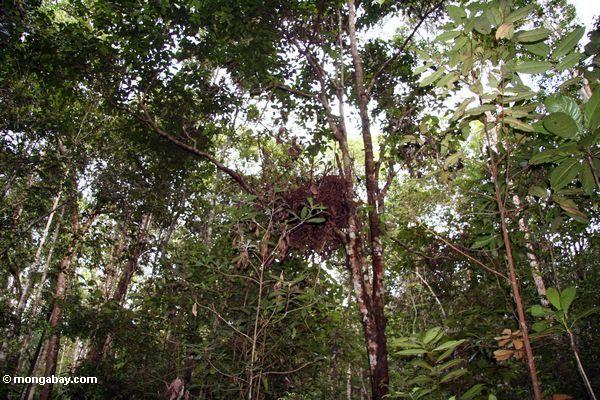
We headed down the Kumai for a little, before heading west on the Sekonyer, a smaller branch. As we sped along, Anang told me to be on the lookout for estuarine crocodiles, proboscis monkeys, and, of course, orangutans. I spotted the snout of a crocodile, but couldn't get my camera out fast enough. While we didn't see any non-human primates, Anang did point out a few orangutan nests in the treetops. At first I thought I was misunderstanding him, but sure enough, orangutans build a new nest for themselves every night.
At some point along the Sekonyer, we officially entered Tanjung Puting National Park, which spans 4,000 square kilometers of rain forest. The park has existed for about 65 years, and was established primarily for the preservation of the Bornean Orangutan. Camp Leakey manages the rehabilitation of captured orangutans, and releases them into the park.
We slowed as we passed some local fishermen, and to wave at some kids on a small dock. We passed by a boat identical to ours with another tourist group, heading back to Kumai. The water in those pictures is brown and cloudy from silt; Anang explained that there is a zircon mining operation far up the Sekonyer, and runoff from the mining is silting up the river.
We soon turned off the Sekonyer to an even narrower river, and the change in water color is remarkable. This type is known as a blackwater river, and gets its color from tannins leached from nearby leaves. There wasn't much of a current, which caused the water ahead of us to mirror the canopy beautifully.
We finally got to a dock where three identical boats were anchored. One of them was ours, and we climbed aboard. The crew consisted of Anang, a cook, a driver, and two other members. I felt kind of silly, having a boat and crew of five commissioned just so I could be an eco-tourist. Of course, it didn't seem to bother them too much, though I did apologize to the guys for not bringing two girls with me.
The cook had prepared lunch for me, and since I was all by my lonesome, Anang ate with me. The meal was simply delicious: rice, steamed vegetables, and grilled chicken. They had brought hot sauce, ketchup, and a sweet soy sauce that was thick like syrup. Having expected to rough it with plain rice and water, I was pleasantly surprised.
After eating quickly, Anang and I set out for feeding time. Twice a day, at two or three places around the park, the park puts out bananas for the local orangutans. This serves several purposes, including helping the recently-reintroduced orangutans who are still learning to fend for themselves, helping the park workers keep track of the orangutans, and allowing an excellent opportunity tourists to view the orangutans.
Anang advised that I bring very little with me, to reduce the chances of an orangutan approaching me out of sheer curiosity. He assured me that the orangutans in the park have not attacked any visitors, but did say that they will sometimes charge at people. He told me that as long as I listened to him, we'd be fine. As he said all this, he sounded serious without trying to scare me. Ever since I set out for Japan, I've taken a remarkably carefree approach to danger like this, deciding that I'm not going to let fear of something awful happening (plane crash, falling off an elephant, being bitten by a monkey, catching malaria, assaulted by an orangutan) keep me from doing the things I want to do. Thanks to that and Anang's frankness, I wasn't the least bit worried about what we'd find.
We started down a long boardwalk spanning marshland. Not five minutes after leaving the boat, we saw this. Anang instantly recognized the orangutan as a female with her baby, and knew exactly which one she was. He warned me with a grin that she is the "naughty one." As we got closer, I managed to get this picture before Anang decided to toss a few bananas into the water off the boardwalk. The mother casually reached for a nearby tree, scaled down it, fished out the bananas, and swung back onto the boardwalk as we briskly walked past her.
As we headed on to the feeding place, we passed another orangutan poking around for food. This one didn't seem to pay us the least bit of attention.
The feeding place is a roughly 10' x 10' wooden platform raised about six feet off the ground. Very little of the forest has been cleared around the platform, and the viewing area consists of two or three simple benches. There were about twenty other tourists and guides gathered, and all of them were sitting in complete silence, watching the platform. We quietly took a seat among them, and watched.
There were a few orangutans near the platform, taking turns grabbing bananas and munching on them. Some were sitting on the platform, while others would take their snack up a nearby tree before enjoying it. As we watched, more of them slowly made their way from all directions toward the platform. Just as with the ones we passed on the way in, none of them seemed interested in us in the slightest. Eventually there were about ten orangutans on or around the platform, just chilling out and eating. Most of them were females, and several of those had babies, which were clinging to their mother's body, occasionally reaching up to take some food. This picture shows a baby, as well as just how close they were to us.
Between us and the platform was the simplest and smallest of fences, clearly intended merely to maintain a minimum distance from the platform. Anang assured me I could go all the way up to the fence; that's where this picture and this picture came from. While I was pausing between shots, staring at the scene around me, and trying to make sure I was really seeing this, a lady next to me struck up a conversation. I learned that she was from Wisconsin, and was on vacation with her husband. Their son is also doing the JET program, and just like my mom would do, she asked if I knew him. As we were talking, her husband heard me reply to her with "yes, ma'am" and "no, ma'am," and so he asked me with a grin where I was from. It turned out that he was from Tennessee, and could tell I was a southerner just from hearing that.
I also saw two familiar-looking guys: the two from the airport the day before, who had managed to get their tickets. We introduced ourselves (they're from San Francisco) and had a laugh about the whole thing. They gave me the rest of their story, which I've already used to sort of retrofit my account of yesterday's debacle.
I made my way back to Anang, who began telling me about the orangutans. They live about fifty years, reach sexual maturity at about fifteen, and are pregnant for nine months, all of which, he pointed out, are similar to humans. The child stays with its mother for about six years, then goes off on its own. According to Anang and every other source I've found, orangutans live solitary lives. Apart from mating and child-rearing, they have little to no social interaction. For all the hullaballoo that we primates get for being social creatures, I find this lack of sociality fascinating.
Camp Leakey specializes in rehabilitating rescued orangutans. They acquire orangutans from several different sources. Some are taken from habitat that is slated to be cleared by loggers, and are relocated to the park. Others are babies that are found alone, their mother having been killed by poachers. Still others are donated by regular people who owned them as pets.
There's apparently a substantial demand for exotic pets, which includes orangutans. In response to that demand, hunters seek out baby orangutans. The mother will not allow her baby to be taken, so she is often killed in the process. The baby is then delivered to the people who ordered it, and raised as a pet. Docile and manageable enough when they're young, adult orangutans (especially males) require a lot more food and territory than most private owners can provide. Once their pet has grown too big for them to handle, the owners turn it over to places like Camp Leakey. There, workers try to rehabilitate it, helping it grow accustomed to living in the wild.
The sexually mature males are fiercely territorial, which explains why the only males we saw at this platform were adolescent: we were in the territory of the biggest male in the park. We talked about this as the others trickled away, watching the orangutans finish their meal--fruit and peel alike--and head back up the trees. I was amazed at how dexterous they were, shimmying up and down trees in a way that made me think of Donkey Kong Junior. Just as we were leaving, we heard a boar rooting around for scraps.
On our way in, we had taken a path away from a group of huts, which Anang had identified as the main buildings of the camp. We stopped there on the way back, and he showed me around. These buildings were situated among the trees, with no barriers of any kind between the houses and the forest. Sure enough, we passed a couple of orangutans in the trees overhead. Anang led me to a house so he could ask one of the workers if they'd seen the big male. The male, nicknamed "Tom" and "The King" by the workers, had been seen nearby just a few minutes before, so we began looking around. After about five minutes, we found him, no more than fifty feet from the house.
Tom was huge. Anang told me he clocks in at about 135kg--just under 300lbs. He's somewhere around five feet long, which makes those 135kg look that much bigger. As we watched, he was just hanging from a tree. He yawned, showing me exactly what a fellow male would have to look forward to in a fight. Anang showed me how close I could get, and gestured for me to stand closer so he could take our picture. While we were watching Tom, I heard a sound, and turned to find that a female had dropped down onto the roof and was nosing around the back of the house. A minute later, I noticed a boar had emerged and was sniffing around the yard. We were literally right in the middle of all this.
Anang pointed out the pronounced pads of skin on either side of Tom's face, and the pouch of skin hanging down from his neck. He explained that males that assert and defend territory develop these characteristics; males without territory don't have them. I later found out that these pads are called flanges, and that flanged males use their throat pouch to produce booming calls that attract females. Unflanged males, meanwhile, have to force themselves on females.
After a few minutes, Tom began climbing away, so Anang and I excused ourselves and hiked on. Anang explained how clever the orangutans are: they are fully capable of opening bolt locks, and can easily untie knots. He told me about an old female who used to get jealous of women visitors to the camp who walked alongside men. She would apparently run up to them, trying to scare off the women. They will also jump into boats, and paddle with their hands. Anang said that park workers who use small boats have to partially sink them to prevent the orangutans from stealing them.
As we were talking, we heard a woman's scream from nearby. It was more angry than shrill, so we ran toward it more out of simple curiosity than concern. We found a mother and her baby eating some rice that was strewn on the ground. Anang talked to the lady who had screamed, and explained that she had found the mother nosing around her stores of rice. She had thrown some out into the grass and shooed them off the porch. As with the rest, the mother didn't really seem to acknowledge our existence. If we moved toward her, she took notice, and would move away by the same distance if we got too close. Otherwise, though, she went about her business. Anang took this picture for me. I grabbed one more before we headed on.
We made it back to the boat and had a snack of chips, small pastries, and tea. The boat had a simple toilet at the back, which included a showerhead fed by a pump that drew river water. Anang called it a "jungle shower." After all the sweating we'd done, I availed myself of the shower.
Anang and I snacked and chilled out on the boat as we headed upstream a little. It was about 5:30, but it was already getting dark. Anang and I talked about all kinds of things. He asked me about America and Japan, and I asked him about life in Kalimantan. He told me about a big tribal war that broke out about ten years ago. According to him, it began when one "ethnic" (the way he described ethnic groups) had declared a certain city to be theirs, and had begun killing other groups in the city. This attracted the attention of all the tribes of the island, who sent their warriors to fight the instigators. Anang's father, the head of one of the local tribes, was killed one month after Anang got married.
He went on to tell me about one of the tribes, the Punan, who are reputed to be the best hunters in the island. They're known for being able to walk at night without any difficulty seeing. I tried looking them up, but apparently there are about twenty different tribes currently identified as "Punan" of some kind or another.
When we planned this trip, we were given two options for sleeping arrangements: a lodge located on land, or the boat itself. Not sure which was better, the three of us split the difference, taking one night in each. Amid all the changing of plans, I decided to sleep in the boat. Anang had brought some mosquito netting that some tourists had left him, so I used one that basically formed a see-through tent. I put on some more mosquito repellent, admired the swarm of bugs clumping around the one light still on (which was conveniently right above my bed), then turned the light off and went to bed. I slept fine--after getting used to a futon on tatami for eight months, it's amazing how easily I can sleep elsewhere.
Wednesday, April 30, 2008

Subscribe to:
Post Comments (Atom)

No comments:
Post a Comment